

In this closing talk, I want to reflect with you on daily life and practice. I express warm gratitude for your participation during these days here. This year two conditions influenced attendance and commitment to the retreat. We began on a Thursday and finished on a Wednesday, overlapping two working weeks, which challenged some people. Some potential participants cancelled because of the intense heat, which affected their capacity to travel. Next year, the seven-day retreat will begin on a weekend and end the following weekend. That schedule offers more flexibility making it easier for people with work responsibilities.
With this closing talk, I wish to explore an expansive view of Dharma practice in daily life. Practice in the Dharma never restricts itself to morning and evening meditation alone. The teachings point to many opportunities, every single day, for exploration and wise application. The noble eightfold path offers a contribution to a noble way of life in daily situations. Each factor of the path supports an ethical, caring, and liberating engagement with ordinary existence.
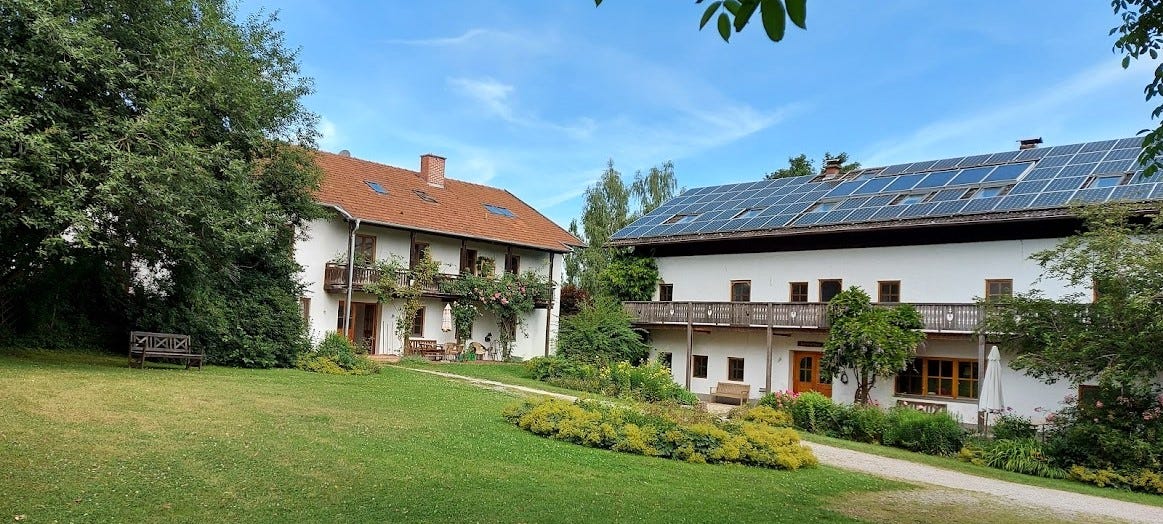
Seminarhaus Engl, a Buddhist retreat centre Bavaria showing exterior of Dharma hall and residence
Consider livelihood as one important doorway into practice and understanding. Livelihood carries two crucial features within the unfolding of the path. First, livelihood rests on ethics, therefore non‑exploitive, non‑abusive, and non‑harmful in attitude and action. It shows care and consideration for the welfare of others and the wider environment. Second, livelihood offers nourishment and fulfilment, so work does not drain the heart. This does not mean work feels easy or pleasant in every circumstance.
Challenging times frequently arise within livelihood, income, and workplace responsibilities. During such periods, activity may not feel nourishing or fulfilling, so reflection becomes essential. We need regular reflection to see clearly how our work affects our life and well‑being.
Whatever the work, remember to end the role at the close of the working day. At the end of a day, a session, or a particular responsibility, know the role finishes. We step consciously into the role, honouring its function, then step consciously out again afterward. Without this clarity, we carry the role around and let it colour mind‑states and impact on our relationships.
A firm inner decision helps: this role finished; now other areas of life call attention. Other areas can nourish us, invite engagement, and expand our sense of being rather than tied down to two or three identities or roles.
Sometimes one area of life strongly demands attention because of unresolved issues or persistent difficulties. Such problematic uses matter much thinking and unwelcome experiences as well. Mental preoccupation and emotional disturbance together absorb huge amounts of time and energy. It becomes worthwhile to recognise any outstanding features of daily life that truly need attention.
When we see this clearly, we recognise a priority within our practice. This priority calls for seeing and understanding the situation with depth and precision.
A common view, for the lazy tendency in ourselves, whispers, “I must accept this.” This kind of vague acceptance does not carry much power for transformation. We can repeat “I must accept” morning, noon, and night, yet little actually changes.
Transformation arises through clarity and understanding, not through mechanical repetition of a spiritual slogan. Clarity may concern workplace issues, family tensions, or other complex areas of life. With clarity and understanding, an important inner shift takes place, affecting perception and reaction.
Allow questions to start with “what,” not with “why.”
Too often we depend on change in another person’s behaviour or attitude for our peace. We hope their reactivity softens, so we feel better and more comfortable. That change may happen, and it may not happen; dependency creates instability. Instead, we assume change in the other may not arrive, so peace cannot depend there.
Then we ask a different question: what do we need to see and know clearly? “What” proves far more helpful than endless “why” questions, which keep problems alive. We can think “why” until the cows come home, yet suffering still continues. Persistent “why” questions often feed problematic mind‑states rather than resolve them.
Many periods in life require considerable attention, yet they do not occupy every moment. We receive natural breaks from problematic mind‑states, and those breaks deserve appreciation. We might read a book, talk with a friend, walk quietly, or do housework. During these basic activities, the disturbing issue often disappears from consciousness for a while. We then recognise a period of absence, a genuine gap within the problematic narrative.
Even highly obsessive minds cannot cling to the same concern every single moment. Breaks inevitably occur; our practice includes appreciating the absence of distress during them. Such appreciation offers context and lets us see how issues arise and pass in experience.
Feelings and use of the mind
Throughout these days we touched regularly on feeling life, happiness, love, and inner nourishment. Experiences of joy, bliss, serenity, calmness, gratitude, and appreciation nourish both wellbeing and benefit others. Support sharing, service, and creativity in many different ways. Some of you work in fields where feeling life receives little priority.
Your work may rely heavily on sound use of your mind, rational clarity, and precision. Engineers, computer professionals, accountants, and similar workers spend long hours in conceptual thinking. Ideally, the mind serves others through such work, so your livelihood contributes to the benefit of society. It may mean that for many working hours, the feeling life remains quiet, muted, or barely noticed.
Do not take feeling life for granted; it can gradually dry up. Numbing may occur. An absence of feeling affects enjoyment beyond the workplace. Without feeling nourishment, enjoyment of life decreases, doubts expand, and meaning feels elusive. We then seek some higher purpose or grand solution, without noticing the heart’s hunger.
We may repeat the question, “What do I want?” while overlooking our deeper need. The deeper need concerns nourishment of the heart through precious human experiences of feeling. These experiences require attention and cultivation, not casual neglect.
Spiritual feeling tones
Our practice therefore involves recognition and development of the range of healthy feeling tones. The Buddha speaks of two ranges of feelings: worldly and spiritual. Worldly feelings arise through everyday activities such as washing dishes, housework, conversation, TV, tablets and everyday travel. Practice invites us to stay in touch with how we feel during such ordinary events.
Spiritual feeling experiences hold equal importance, not necessarily greater importance. They emerge through wonder, such as the freshness of a new day after rain. We see deep green foliage, feel gratitude for rain, and sense intimacy with the creature kingdom. Spiritual feelings also appear through the arts: music, dance, literature, poetry, and theatre. We need the arts urgently; they confirm and express a spiritual dimension of life. Through the arts, nourishment and well‑being increase, and we avoid drying out inwardly.
Live arts carry special power and offer real support to our inner life. Please support precious artists in various ways, including your respectful, appreciative presence. Your presence affirms their work and contributes to a shared cultural field.
Another important area concerns contact like‑minded people and active communities. Much activity unfolds everywhere; more goes on than many people realise. In every city and town, people undertake remarkable projects and gatherings. We need open eyes and ears, a willingness to go out even on harsh nights. Cold, snowy, wet, and windy evenings still offer opportunities for meaningful connection. You go out because something calls you: a talk, a group, or a meeting.
Teachings without walls and boundaries
Dharma teachings function as teachings without walls or boundaries. We need not follow teachers who try to confine us to one practice or tradition. If teachers demand we only follow their method, their form, and nothing else, we take care. Such confinement does not lead toward freedom; it leads toward imprisonment. Some sects and cults grow around charismatic teachers making exclusive claims. They think they act for our welfare, yet often they engage in empire‑building. We need freedom, not entrapment in any spiritual or psychological system. Any rigid meditation system that denies exploration insults our intelligence.
We must preserve freedom, especially the freedom to explore diverse practices and perspectives. We do not allow any guru, psychologist, or group to take that freedom away. They may warn that other things will confuse us, they do not realise they reveal their own confusion. Such teachers lack trust in our capacity to discern valuable experiences for ourselves.
Freedom remains freedom, a precious transcendent reality and essence of the larger vision. Small things and big things alike can nourish and benefit daily life. One teacher concluded a retreat with three simple words: outdoors, outdoors, outdoors. This reminder encourages genuine contact with the world beyond enclosed spaces. People sometimes tell me, “I love the outdoors,” and I feel glad. Then I wonder when they last truly spent time outdoors, beyond shopping and errands.
To be outdoors means to be present with land, sky, and weather. We can walk the streets simply for the love of walking. We can wander through parks, resting under trees and watching people and birds. We can take a bus away from town and spend a day walking. No city extends endlessly; fields and tracks lie within reach. Bus journeys cost little; a day alone or with a friend brings nourishment.
If we spend the entire outdoor day talking, we remain mostly inside each other’s thoughts. We stand outdoors physically, yet the environment receives little attention. To experience outdoors fully, we can agree on periods of silence. Silence helps us feel the world, rather than continually narrate about it. Such time offers welfare, nourishment, support, and freeing up of our being.
Retreats and Roles
Retreats offer another essential form of practice and breakaway. Each year many good friends commit to attending at least one retreat. Retreats provide genuine separation from usual forms, patterns, and social networks. Silence forms a key feature and enables deep listening and inner quiet. Retreats help us break away not only from situations and people but also from roles.
We need clarity about the roles we hold in life. We can name primary roles, then sense being human without constantly carrying them. Retreats and the outdoors support presence without a role. That experience opens space, a spaciousness beyond our usual self‑images. Such space holds enormous value; it allows consciousness to move into depth. When thought, roles, and identities no longer occupy every corner, consciousness naturally goes deep. We do not need to push consciousness; it moves organically where space appears.
In the deep, we discover the jewels of life. We touch areas needing attention, healing, or integration. We encounter experiences never previously known in our lives. Mindfulness and meditation serve as supports, not final goals. To think mindfulness exists simply to create a mindful person remains kindergarten thinking. Mindfulness offers a doorway that grants access to deeper levels of being. Its value lies in the space it opens, not in mindfulness itself alone.
Through meditation, awareness, contact with nature, and deep listening, more space appears. Within that space, profound experiences may arise and sometimes radically change our views. Love and compassion often emerge from that depth, along with increased trust in existence. The best of human being reveals itself in the deep. Many practices point again and again in this direction.
People sometimes tell me they never had a deep experience in their life. They say this on retreats, in emails, and in conversations. I asked whether they felt truly clear about this statement. They reply with certainty, “Yes, never, absolutely never.” I respond that such a statement itself carries deep significance. It may be true, though I hold some doubt about their history. To say, with conviction, “I never had a deep experience,” already expresses depth.
Then another question arises: if deep experiences feel absent, what changes will you make? What changes would support deep experiences over the coming year or beyond? Perhaps one day you say, with equal clarity, “I have known deep experiences now.” That possibility deserves careful thought and practical steps.
Dharma teachings remain empirical. They point directly to lived experience, not abstract conceptual speculation. We do not require scientists to tell us the nature of reality. Scientists hold legitimate perspectives, formed through training and disciplined inquiry. Their perspective offers value yet also carries limits. Scientific approaches usually exclude consciousness, heart, deep awakening, and profound engagement with the world.
The reality of human experience
Yet these dimensions belong to the reality of every human experience. As human beings, we hold the authority to speak about reality in its fullness. We include science, ethics, economics, religion, and spirituality in our exploration. We set no artificial limit on inquiry, and this absence of limit matters deeply. A free life avoids contraction within any narrow frame.
We appreciate ethical scientists, ethical politicians, artists, families, and ordinary people. With ethics and care, our support flows naturally. Where ethics seems lacking or harmful, there is a duty to find our voice. We criticise, express concern, and protest respectfully. There are discoveries more profound than unwholesome or harmful behaviour. This becomes part of our engagement and exploration.
There is no need to use repeatedly the words Buddha, Dharma or Sangha. We do not depend on those concepts for authenticity, nor depend on the words mindfulness or meditation. We live as free human beings, using concepts only when they serve communication. When concepts no longer serve our focus, we drop them.
As you leave here, some of you return to homes, families, and workplaces. Some relatives may have urged you strongly to come, hoping you would gain benefit. When you go home, please avoid returning as missionaries. The world already holds enough missionaries. Dharma missionaries do not offer what the world most needs. The tradition itself discourages missionary behaviour and conversion of others to a fixed set of beliefs.
Instead, go home with friendship and kindness. Do not walk through the front door demanding a spiritual discussion with loved ones. They probably will not say, “Wonderful, we happily await your wise critique.” Rather, they might search spiritual magazines for another retreat centre to send you to. Kindness carries enormous power, both outwardly and mentally.
Let us now rest together for a quiet minute.
May all beings apply practice in appropriate and skilful ways.
May all beings appreciate the support and benefit that others offer.
May all beings live with deep wisdom around the human experience.
Thank you; the world returns to us, and we return to the world.
Dear Christopher - thank you so much for sharing this transcription! It was just what I needed to hear - and there is a warm and softened heart here now. Deep bow <3 Amanda