

Introduction
This essay reveals the power of a sudden, unexpected interruption that triggers deep questions about control, fears and fearless compassion. When a rapper spoke for just two minutes at an Ed Sheeran concert, an entire tour shook. Associate singer Macklemore said “Free Palestine” to 60,000 people and named Gaza’s suffering. Billionaires, promoters and pop stars then showed how power responds to conscience in compassionate or repressive ways. Following the sequence of events, this essay explores that moment through to the Buddha’s teaching on “eel wrigglers” – those who slide away from moral questions. This essay asks what silence, speech and responsibility mean in a time of mass killing.
The Buddha, Palestine, Ed Sheeran, Macklemore, Pink and Noble Minds
Earlier this week, Nshorna, my daughter, rang me and asked, “Have you heard the news?”
“What news?” I replied.
She then told me the story of the international social media uproar that followed a 2 minute 7 second call to “free Palestine”, to an audience of 60,000 at an Ed Sheeran concert at the MetLife Stadium in New Jersey, USA.
This essay offers the background to the incident, plus a Buddha-Dharma perspective.
UK singer, Ed Sheeran stands among the most successful pop stars of this generation. He has accumulated an estimated wealth of $400 million, sold more than 150 million records globally, gives huge concerts and attracted billions of streams. In around 15 years, he has drawn millions of followers on Instagram and other social media.
Earlier this month (September 2026), during Ed Sheeran’s U.S. “Loop” tour, his long standing support act and good friend, Macklemore, a singer from Seattle, stepped up at MetLife Stadium and spoke for just over two minutes calling for a” free Palestine.”
Posted on YouTube Macklemore’s full appeal at concert.
Full Transcription of Macklemore’s Voice at the Ed Sheeran Concert
“I’ve been trying to figure out a way to say this all day.
One of the reasons why I wanted to come on this tour was because I wanted to stand up here on stages and stadiums across America and say two words that are very near and dear to my heart, free Palestine.
I said, “Free Palestine.
I want those words to be loud and clear, so that people from Gaza all the way to the occupied West Bank know that we have not forgotten them.
And this next song was inspired by the bravery of Columbia University students who led an encampment movement that mobilised the entire world, opened up hearts, myself included.
So thank you to those students that risked their diplomas, that risked their tuition, that risked their scholarships, that stood up and said no.
CUAD students, Students for Justice in Palestine, and Jewish Voices for Peace.
Thank you guys to all of my Jewish brothers and sisters, criticism of Israel, criticism of apartheid being against genocide in no way is a criticism of you.
My message is for peace, love, for all human beings to be treated with dignity, respect, and equality.
So I say, free Palestine.
I say, free Lebanon.
I say, free Cuba.
I say, free Congo.
Free Sudan.
Free all people in America living in fear over this terrorist organisation, ICE.
None of us will be free until we are all free.
This song is called “Hends Hall.””
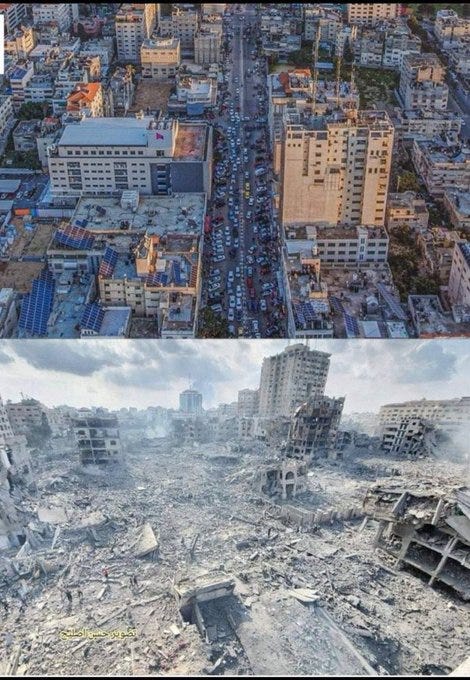
Gaza. Before and After Israel’s government and IDF war on Gaza
Billionaires, Venues, and Punishment
The Israeli American Council and the group Stop Antisemitism launched a petition demanding Macklemore’s removal from the tour. They accused him of antisemitism, although he did not criticise the Jewish community—only the policies of Israel.
Tour promoters and billionaires then tightened control over the concerts. Ed Sheeran, whose public role has focused on pleasing people and making them happy, suddenly found himself in the centre of a volcanic media storm and on the horns of a dilemma.
Ed Sheeran’s Response and the Dilemma of Silence
Sheeran stated that the decision to remove Macklemore came from the promoters, not from him. He said:
“Macklemore coming off tour was the promoter’s decision; it was not mine. I am appalled by the conflict between Israel and Palestine. The suffering and pain on both sides is a human tragedy. I am not complicit. I have my personal views on this devastating conflict. Just because I choose not to speak publicly doesn’t mean I don’t have them and it doesn’t mean I don’t care.”
Sadly, we still do not know his views; they remain in his privatised inner world, where they have no influence.
After Sheeran’s statement, other musicians on the tour stood with Macklemore and announced they would also step down in solidarity. The musicians, Phineas, Aaron Rowe, Lukas Graham, Biig Piig and others—announced they would withdraw from the tour.. They protested against the silencing of a fellow artist who spoke up for Palestinians in Gaza and the West Bank.
The Messina Touring Group and venue owners moved quickly. MetLife Stadium announced they would not host Macklemore again. Robert Kraft, billionaire owner of the New England Patriots and the Gillette Stadium in Massachusetts, also banned Macklemore from performing at his venue.
Kraft, of Jewish origin, gives substantial financial support to Israel.
Macklemore and his fellow stage artists took a noble risk. Artists often rely on big tours for their primary income. To quit a tour means a huge financial loss and perhaps exclusion from future big stages.
Tour organisers and Robert Kraft wanted to send a message: punish one artist, and this will frighten the rest from speaking up on any global issue. The dismissal of Macklemore will make any artist or musician think twice before offering a compassionate message from the stage, even though it was a mere two minutes and seven seconds out of three hours.
Kraft described Macklemore’s brief speech as “hate speech.” Does Kraft’s statement and exclusion of Macklemore reveal hate speech? The tone and content of Macklemore’s words did not target the Jewish community. He spoke against genocide, apartheid and state violence. Yet powerful voices smeared him as hateful to silence a moral appeal.
At stake lies a deeper question:
Should artists use large public platforms to express moral views when suffering reaches extreme proportions?
To dismiss such expression as “too political” shows a mean to suppress moral concern. The magnitude of suffering in Gaza, the West Bank and elsewhere does not belong only to politicians. We cannot hand morality over to politicians and walk away. At some point, the duty—one could say the Dharma—falls to ordinary citizens: artists, audience members and all of us, to express concern about such suffering in Gaza, the West Bank or anywhere else.
Children, Suffering, and Selective Concern
As often happens, attention drifted from Palestinian suffering to the social-media storm that followed. Fierce criticism exploded online. The American singer Pink, a 47‑year‑old of Jewish descent, launched a reactive tweet about Macklemore’s on stage voice. She accused him of affecting Jewish people and children in the audience. Ed Sheeran used similar reasoning to justify his reluctance to mention Gaza and Palestinian suffering.
Meanwhile, more than 20,000 children in Gaza have died. Thousands more have lost limbs, lost their eyesight and will endure lifelong trauma because of the genocide. The death toll exceeds 75,000 citizens, plus an estimated 30,000 people missing in the rubble, and a near‑total destruction of culture through the levelling of 90% of Gaza.
Yet, we are told a two‑minute appeal to “Free Palestine” threatens children.
If that holds true, then politicians should also pass laws to stop children staring at the evening news on television with the images of war and horrendous detailed reports much more intense than Macklemore’s short appeal. In religion, rabbis should cease upholding the First Commandment that their God gave to Moses—“Thou shalt not kill” if they refer to genocide, war and murder and the suffering imcurred. In sport, footballers should no longer take the knee at the start of matches to protest against racism because that’s political, as well as moral. In art, filmmakers should abandon movies based on actual events in case the vulnerable watch and so on.
In my view, a concert offers an excellent environment for a two-minute statement of deep concern about suffering. No wonder thousands spontaneously applauded Maklemore for making clear he made no criticisim of his Jewish brothers and sisters.
Macklemore had expected to earn around one million dollars from the Sheeran tour. He decided instead to donate this sum to six Palestinian organisations, redirecting public attention toward Palestine
American born singer, Pink entered her views. On Instagram she wrote:
“I was born a Jew. I didn’t pick it, and I’ve never hidden it. Hamas is a terrorist organisation. No child’s death should ever be celebrated.”
She reposted a message from a Zionist group and affirmed her wish for peace while refusing to “pick a side that celebrates death.”
Later, she clarified that she did not object to the words “free Palestine” themselves, or to Macklemore’s right to speak. She objected to him, as she saw it, “telling all the Jews in the stadium that it wasn’t about them.” She insisted, “You don’t get to decide that for us.”
The same principle applies to Pink. She also lacks authority to decide what other Jews experience when they listen to a moral and compassionate statement.
Macklemore tried to separate criticism of a state and a system from criticism of a people. He spoke against genocide and apartheid. The Israeli government, meanwhile, chose policies that led to tens of thousands of deaths and the near‑total destruction of Gaza.
Moral clarity here does not equal hatred of Jews; it shows a refusal to accept mass killing and destruction, whoever carries it out.
Three Choices for Ed Sheeran
The social media storm forced Ed Sheeran to face a simple but uncomfortable question:
Does silence amount to neutrality?
Does silence function as a political or moral choice with consequences?
Macklemore inadvertainly cracked the glossy public‑relations image that surrounds Ed Sheeran and his concerts—an image of friendliness, non‑controversial charm and universal likability. Sheeran knows Macklemore is an outspoken activist and so his friend’s voice and images of Gaza would not have come as a surprise.
Sheeran now faces at least three choices:
Continue the tour alone, without a support singer and backup group.
Continue the tour with a new support singer and group, replacing those who left in solidarity.
He could use his status as an international star to take a moral stand—publicly name the suffering in Gaza and the West Bank, and give a significant donation to Palestinian charities in a visible, accountable way.
If he continues the tour in the way the promoters want, he will probably claim it reflects his “loyalty to my fans.” He may not wish to “get involved in politics;” it may not be his cup of tea, as it is for many. To a degree, he gets my support.
That does not mean he has to exclude artists lilke Machemore, who have a voice. Sheeran can put the demands of the corporate world before the suffering of Palestinians. In that case, powerful corporations, billionaires and corrupt governments willl exercise total control over his life and over the lives of global artists. That’s choice Sheeran has to make. Some would regard it as a political/corporate and/or self-interest choice.
Media reports already indicate that a growing number of fans want to sell their tickets to upcoming Sheeran concerts rather than associate themselves with the Ed Sheeran brand; they struggle to sell those tickets.
Sheeran could easily donate one percent of his personal wealth to support the people of Gaza and the West Bank. His moral concerns and values require more than private feelings or vague language; they now call for specific speech and visible action, not abstractionson. On behalf of Palestine, one of his fellow artists can make a brief announcement during his concert calling for then of suffering.
The Buddha, Ed Sheeran and “Eel Wrigglers”
Ed Sheeran might benefit from readings the words of the Buddha, who spoke directly about eel wrigglers in the Brahmajāla Sutta (Discourse of the Net of Views). Eel wrigglers form a vivid metaphor for people who avoid responding to profound moral questions because they fear judgment for what they stand for.
An eel‑wriggler twists and slips away like a slippery fish. Through silence or evasive words, such a person avoids any clear stance. Their language stays vague, insubstantial and non‑committal. This habit often comes from a desire for self‑protection—protecting image, comfort, commercial or financial interests.
The Buddha described evasive people who say:
“I don’t say this.
I don’t say that.
I don’t say otherwise.
I don’t say not so.”
Such a person refuses to affirm or deny anything, in order to avoid criticism. Four main fears live in the mind of the eel‑wriggler. Dear Ed, Take note: Do you fit into one or more of these categories?
Fear of upsetting others – “My view might disturb fans, friends or business partners.”
Fear of controversy – “I can’t handle criticism or look ‘political’.”
Fear rooted in confusion – “I don’t clearly understand the situation, so I freeze.”
Fear of making a mistake – “What if my statement turns out wrong or harmful?”
Ed Sheeran might feel all four fears. Together with his PR and marketing consultants, he has carefully built a public image as a friendly, accessible, unthreatening figure. That may well be his authentic persona - a soul who wishs to please.
Eeel wrigglers may not reveal in their evasion of moral issues, nor show indecision but it can go on in their mind giving them sleepless nights.
Yet 2 minutes and 7 seconds of Macklemore’s speech exposed the vulnerability of his long‑standing image of himself and others have of him.
It would be unfair to attack Sheeran. One militant left‑wing columnist, Owen Jones of The Guardian, called him a “coward” in a self‑righteous onslaught on YouTube. Jones might do better to stick to his day job than take on the role of a psychologist of a respected entertainer.
Dharma teachings encourage something different: mindful speech, dedication to truth, reflective inquiry, open sharing and fearlessness.
Remember Ed Sheeran’s Concert for Ukraine
Ed Sheeran has not always kept his professional platform separate from war and politics. In March 2022, he performed at Birmingham’s Concert for Ukraine. Days beforehand, in a public message to Ukrainians, he said:
“I love you; I stand with you.”
Easy to say. Love reveals itself in the actions to end suffering. The concert functioned as a humanitarian fundraiser, not an ordinary commercial date, but it still showed his willingness to link his public voice and musical standing to a people under military invasion with no reference to the suffering of Russian soldiers and an increasing number of suffering Russian citizens.
Resolution of suffering comes through persistent campaigns for both sides to meet, listen and negotiate a settlement. With Ukraine and Russia, it calls for both governments—and NATO—to work together, for as long as it takes, to reach a common, lawful agreement.
The same principle applies to Palestine and Israel, and to the primary backers of Israel—the USA, Germany and the UK. Dialogue, negotiation and restraint do not contradict moral clarity; they depend upon it.
The “Both Sides” Escape Route
Another form of eel‑wriggling takes shape in the “both sides” escape route:
“Both sides do wrong,” followed by silence.
“The situation is complicated,” and nothing more.
“Who am I to question what’s right?” followed by inaction.
These escape routes act as masks to avoid a firm moral position on suffering and its causes.
The refusal to name grave suffering—such as in Gaza—alongside the injustice and cruelty that generate it, grows out of fear. In such cases, silence supports the status quo. Dharma invites us to speak with moral clarity, even when power, money or eel‑wrigglers pull in the opposite direction.
Following the incident at his concert, Ed Sheeran reportedly lost around 200,000 Instagram followers within the first 24 hours of the concert, plus many other followers on different platforms. This shows that people now look closely at the choices of public figures. Increasing numbers no longer accept “neutrality” while bombs fall on children.
We Cannot Leave Moral Questions to Politicians
One central lesson from this episode: we cannot hand urgent moral questions over to politicians and billionaires and then retreat into private life. The uproar over a two-minute speech reveals a deep wellspring of protest around the world towards the powerful and the rich.
Politicians dominate the airwaves. The wealthy decide what counts as acceptable speech in stadiums, media and major public platforms. Venue owners and sponsors often set the boundaries of “acceptable” views/opinions, namely tepid and vague in its generalisations. There is enough of that in the Buddhist world, including, at times, in its loving kindness meditations.
A Dharma response does not demand perfection from public figures but calls for actions and words grounded in wisdom and compassion to end conflict and ongoing war crimes.
It reminds us to look honestly at fear, to notice where we wriggle away from moral clarity. The Buddha’s teaching on eel‑wrigglers applies today to celebrities, promoters, billionaires and everyone of us.
In an age of livestreamed bombings and daily terror on the ground, silence no longer looks neutral. Our silence has real consequences for those who suffer.
Real power rests with the people—not with politicians, profiteers or pop stars.
Let us make that clear.
Thank you, Macklemore, and thank you to the other musicians who expressed a noble mind.
We are await to hear of Ed Sheeran’s next step.
Five Questions for Reflection
When do I stay silent about injustice, and what am I afraid of?
What differs prejudice towards a group from criticism of a government?
Does my job and social/public image limit what I say?
Where do I use “both sides” or “it’s complicated” to avoid find my voice?
What does mindful, caring and wise communication sound like or read like?
Christopher Titmuss gave annual teachings and practices in vaious formats on the resolution of suffering in Israel and Palestine between 1992 and 2019. He remains supportive to co-existence and freedom of movement through the one-state solution, if possible. Palisrael.