

I love the teachings/practices of dana (donation, generosity, gift), in the Buddhist tradition including the liberating depths of exploration and challenge.
Surely the English language word dona-tion has its origin in Sanskrit and Pali language (language of the Buddha).
This essay includes a range of quotes from the Buddha on dana, reflections and personal stories.
A couple of kilos of bananas
I first learnt about dana while staying at Wat Suanmoke (Monastery of the Garden of Liberation) near Chai Ya, southern Thailand.
I spent about three weeks in the monastery with regular conversations with Ajahn Buddhadasa, the great sage of Thailand of the 20th century. At the end of the stay, I asked Ajahn Poh, the deputy abbot, how much per day I needed to pay for my stay. At this time, I had been on the road for three years, travelling around 20 countries, living on a tight budget.
Ajahn said, ”There is no daily rate. We do not ask for payment. The monastery runs on dana, the practice of generosity.”
“Ajhan, then please give me a rough figure on the amount to give for the food and time in the hut”
He took one look at me in my well-worn clothes, long hair, unshaven face andhalf empty backpack bought in an army surplus store in Croydon, England. wearing worn shoes that hadn’t seen polish for three years.
The Ajahn smiled and said:
“Go to the market and buy a couple of kilos of bananas for the monks and nuns as your dana to the monastery.”
About 60 monks lived in the monastery, some nuns and laypeople. I went to the market to buy some bananas.
Wow. The suggestion of a few bananas touched a spot. Four months later, I ordered as a Buddhist monk. It was the start of a dedication to the Dharma and dana.
Nearly all the income after I disrobed in 1976 comes through dana, covering a wide range of expenses including family life. The Sangha gave dana enabling me to put down a deposit on a modest three bedroom terraced £24,000 home in Totnes, Devon, England in 1982, and support for the family for decades.
I still live in the same house that I share with D’nae, 19, my granddaughter. Publishers offered me a modest advance of my books. I never employed an agent to negotiate the advance and instead accepted the advance as a dana. Publishers often came back to me to write a second and third book kmowing they did not have to engage in a price negotiation.
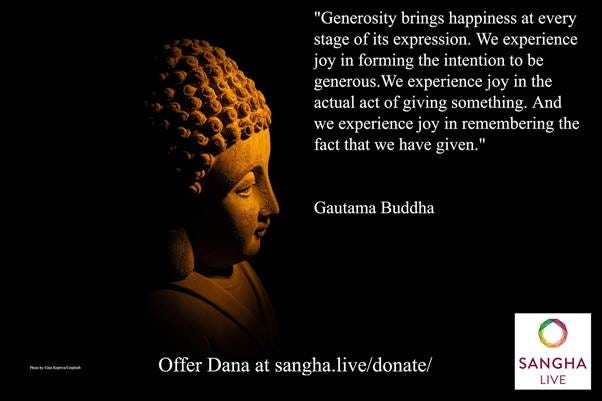
Last week, Monday to Friday morning, 13 - 17 July 2026, I offered five online sessions for 60 minutes on the theme Resting in Being. A Major Step towards Full Awakening - invitation of Sanga Live. Each morning at the end of the session, I spoke a couple of minutes on dana for SanghaLive and this wallah. This is the beautiful graphic following the request.
The Buddha’s teachings on Dana
As always with the Buddha, there is a depth of exploration of teachings on every as aspect of human existence. This includes our relationshio to giving or receiving a gift or donation in clear minded, insightful and meaningful ways. The Buddha used the opportunity to explore dana as a noble expressions of the human spirit. He also pointed out the benefits for the giver and the recipient.
Ever vigilant with his reflections, he showed how the ego can exploit, corrupt or use dana so the giver ends up prioritising self-interest in the act of giving.
The Buddha referred to three supports for giving
1. The intention to give support worthy of benefit to the recipient(s)
2. The action of giving support worthy of benefits to the recipient(s)
3. The reflection afterwards for giving and benefits for the recipient(s)
Dana includes giving energy, knowledge, money, skills, time, goods and more for the wellbeing, waking up and liberation of others.
A noble donor is one who is happy giving before, during and after giving (A.iii,336). Such giving holds no desire for the giving to make one happy.
Happiness is a gift emerging out of the being. We can give out of trust, fearlessness and recognition of the necessity. Happiness may not always come as a gift from the deep, and it does not need to. Noble ones understand this.
One can experience happiness with the intention before the giving
One can experience happiness offering the gift.
One can experience happiness afterwards knowing the benefit for the recipient(s)
Ego casts a shadow or corrupts the joy of giving.
The Buddha looked into the ego and its influence. We will probably recognise these expressions of ego in acts of giving, whether making donations for political, social, secular, religious reasons or for the individual(s).
A frequent example. the giver wants something in return. Noble giving carries no such motive. A freely given donation serves as a worthwhile benefit to the appropriate person(s) take priority. Happiness comes naturally, not out of desire.
Not even a thank you
Ajahn Buddhadasa received the dana for the monastery from the laypeople who travelled from all over Thailand. In my months in the monastery, I never heard him once say “kop khun” (thank you) in the formal language of Thai) nor “kop chai” – everyday Thai language to the donor.
I asked why. He smiled. “To give dana means there is nothing for the giver to receive. If I say “Thank you” the giver is receiving two words in return. Dana then becomes an exchange.” He applied the principle to Prime Ministers and the poorest of the poor who came to offer dana.
I come from the English culture embedded in our DNA words like ‘please’ and ‘thank you.’ No way would I adopt his silent response to donations in the UK or elsewhere.
Eight motives under the influence of ego for giving dana
The Buddha gives a list of eight primary motives under the influence of ego
The discourses (suttas) of the Buddha record questionable motives for acts of generosity. From the Numerical Discourses of the Buddha Nikaya (A.iv,236).
One gives with annoyance to offend or insult the beneficiary
One gives out of fear, such as being rejected if one does not give, or giving and bein in fear of hardship
One gives to impress others
One gives in order to get something in return sooner or later
One gives to develop a positive reputation
One gives with unclear motivation
One gives to gain fame.
One gives to adorn the mind (feel good about oneself).
Elsewhere the Buddha refers to two more expressions of ego.
1. Giving to support harmful causes
2. Giving with harmful motives.
Miserliness, self-interest and ignorance (of the needs of others) also inhibit giving. S.i,18
Wisdom of Giving
The wise act of giving reveals the best of our humanity. A gift can express the freedom to give as one of the many expressions of liberation available.
The Buddha said if one knows the value of giving, one will share one’s food with another who is hungry. He referred to the destitute, beggars, the poor, the sick, spiritual renunciates, religious practitioners, guardians of religion (Brahmins), creatures and the natural world as worthy of donations.
The Buddha said a wealthy person who gives to those in need has two eyes - inner (self/family) and outer for the welfare of others. One who only earns wealth for oneself/family is a one-eyed individual (A.i,129-30).
The Buddha said we have four primary purposes for money. To:
Earn money in ethical ways
Use money respectfully for necessities for oneself, family and others
To save money for the future if financial circumstances change,
To give donations to those in need.
One gives out of consideration and respect for the recipient including person/people/organisation/sangha. The Buddha also reminded donors: one reaps what one sows. S.i,227.
Those worthy of dana
The Buddha mentioned some of those worthy of dana.
Cultivate and develop the ethics of non-violence and non exploitation abide worthy of dana.
Cultivate depths of meditation, love and liberation are worthy of dana.
Live with love/loving kindness (metta) for all
Those who abide with insights and understanding are worthy of dana.
One gives out of consideration and respect for the recipient so that the person/people feel understood and appreciated. The Buddha reminded donors: one reaps what one sows. S.i,227.
In the Dhammapada (Verse 354), the Buddha stated that no material gift is superior to the sharing of the truth, as it is the gift that ultimately eradicates craving and leads to the end of suffering.
Teachings acknowledge three types of giving.
Material giving
Fearless giving
Offering wisdom (Dhammadana) to enable others to come out of suffering.
Dharma refers to deep expressions of ethics, love/compassion, mindfulness/meditation, insights, wisdom and liberating realisations.
The Buddha categorised generosity into several frameworks based on motivation, the material given, and the spiritual maturity of the giver.
Significance of Intention
In the Dāna Sutta (AN 7.52), the Buddha details how our internal motivation can have an impact on the outcome
Giving out of habit: Giving because it is a family or cultural tradition.
Giving out of empathy: Giving because you see suffering and think, “It is not right for me to cook and eat while others go hungry.” We witness the benefits of giving.
Giving with expectation: Giving expecting to receive something back, or for worldly, religious or spiritual praise. Mind can react negatively when we don’t receive the attention we expect.
Teachers, managers and others who provide a service to need to be vigilant. Two extreme views can come out of the mind.
1. Idealism.
2. Realism.
Idealism can enter the world of dana. One senior monk based in the West discouraged Western lay teachers of Dharma from asking for dana at the end of retreats. He advocated only putting a dana bowl without an appeal for donations. The monk adopted an idealistic view, assuming will give practical support. It is easy for a monk to adopt such a view since lay Buddhists know the monk lives on donations. Monks know lay Buddhists will provide all his basic needs, such as food, clothing, accommodation, travel and medicine.
Retreatants might think the lay teacher receives payment for Dharma service from their payments for the retreat. In Thailand, Abbots regularly ask for donations for specific needs from buildings, to maintenance, sets of robes and more. It is foolish to imagine retreatants and laypeople know the needs of the centre, monaster, workers or teachers.
Realism matters too. During Covid lock down, I gave a 60- minute weekly Dharma course on Zoom to around 90 participants, who signed up. I spoke briefly about the dana for daily life expenses for three minutes at the end of each session, including admin to put the course together. The number attending each week went up and down. In total, three people gave dana, one dana was for €5.00. A small dose of realism came in. I invited for the next series people to pay $20.00 for the six weeks with a full scholarship for those with challenging financial circumstances.
Three Classes of the Giver
The Buddha also referred to three types of givers based on the value of what they share:
Giving away items that are inferior, old, or of lower quality than what you keep for yourself.
Giving items that are equal in value and quality to what you use yourself.
Giving away the best of what you have, even if it means you must do without.
The term Dānapati (lordly giver) refers to the most noble form of giving. See Serī Sutta (Samyutta Nikaya 2.23) and the Velāma Sutta (Anguttara Nikaya 9.20
During my years as a monk, I spent a month or two in Kolcotta, India. It gave me the opportunity to have 1-1 meetings with beloved Mother Theresa. I discussed donations with her since she relied totally on them for her nuns in the Missionaries of Charity, the hungry, the sick, the lepers, unwanted babies and the elderly, often found dying in the gutters that the nuns and volunteers looked after.
In one of my conversations with her, a nun knocked on the door. “A truckload of broken biscuits has arrived from a biscuit factory. Could you say a word or two to the manager of the factory?
Mother Theresa returned after a few minutes. We continued our conversation. “Deep giving starts when it hurts to give,” she told me. “A person knows deep down the importance of letting go to give or to donate. The person resists. All giving is a preparation for such challenges in giving.
She pointed to a ring on her finger. “I am married to Jesus” she told me. Jesus gave his life in service to others.”
Radical Voice on Dana
In the Velāma Sutta, the Buddha offers radical teachings on dana. He makes a shift away from material size of the gift to the purity of the intention as primary, telling a graphic story to make the point.
Velama, a billionaire, gave away 84,000 gold trays, 84,000 elephants, 84,000 silver chariots, 84,000 milk cows, and massive quantities of food and clothing. (84,000 represents an infinite amount) but no one appeared worthy of such a gift. What might be the consequences?
The Buddha wished to remind us that giving away mega sums of money blindly might bear little spiritual fruit. The giver needs to know the receiver – ethics, sensitivity, respect, integrity and application of donation received.
Those who give donations, big or small, need to reflect on numerous points, some detailed in this essay, on giving, donations, acts of generosity and the intentions.
The Buddha explains that a gift’s spiritual return expands if based on the spiritual purity of the recipient. For example, he said: “Feeding the entire Sangha of noble ones and the practising community headed by the Buddha excels feeding just the Buddha alone.”
Beyond Material Gifts
The Buddha made another bold statement. Non material or spiritual dana ranks above material dana, He gives example of the non-material.
Taking refuge in Awakening, Dharma, and Sangha
Developing the five ethics (sila) of abstaining from killing, stealing, sexual abuse, lying, and intoxication).
Developing a mind of love, loving-kindness and friendship (metta)
Developing the perception of impermanence (anicca)
These four areas take one close to liberation. Karaṇīya Mettā Sutta provides the core internal attitude needed for the practice.
Classification of Beings
The Karaṇīya Mettā Sutta instructs the mediator to encompass every biological distinction to ensure we do not omit anyone or any creature from metta.
State of mind
Size (physical)
Visibility (features, appearance)
Distance (live near or far)
Time (alive and to be born)
Immeasurable Abidings)
The Subha Sutta (Digha Nikaya 10) said radiate a mind filled with loving-kindness to the East, to the West, to the North, to the South, Above, Below, and All Around.
“Pervade the entire world with a mind wide, expanded, boundless, free from hostility, and free from ill-will.
The spreading of metta includes “whether standing, walking, seated, or lying down, as long as one is awake, one sustains this recollection.”
Speaking to those of religious leadings, he referred to this expansive, boundless metta as Brahma Vihara – literally Abiding with God, Abiding with the Immeasurable. Metta ranks alongside the depths of compassion, appreciative joy and equanimity/resilience as a divine abiding.
Metta makes dana possible. Dana makes metta possible.
Awakening generates freedom, service and the wisdom of giving.
The Buddha makes clear to humanity the power of dana as one of the ways to change, to transform and to awaken life, near and far.
Final Word
Two much loved statements of the Buddha
“Just as a mother would protect her only child with her life, even so let one cultivate a boundless love towards all beings.” (Karanoya Discourse on Loving-Kindness), which is found in the Sutta Nipata, verse 149)
“The Sangha has a priceless gift to give, the gift of the Dharma. The gift of the Dharma excels all other gifts” (Dhp. 354).
Dharma refers to deep expressions of ethics, love/compassion, mindfulness/meditation, insights, wisdom and liberating realisations.
May all beings know the freedom to share
May all beings know the freedom to give
May all beings know love and liberation.
Our precious interfaith Prajna Vohard School in Bodh Gaya, Bihar, India provides a comprehensive education for more than 400 poor children, aged 5 to 16, plus the arts, environmental awareness, yoga, mindfulness, equal opportunity for girls and boys and meditation. Read about the school with 100 photographs, big and small and short videos. Our school is truly worthy of offering a dana. See link on home page for donations.