

Power of Consciousness Part Two.
Sub-title. Depth, Grounding, and knowing an integrated life.
Part Two. I invite readers to live deep questions and to recognise the web of life alongside liberation from suffering.
Mindfulness of breathing functions as a training. Like any training, it unfolds with fluctuations: two steps forward, one step back; sometimes two steps forward, three steps back. At times, we calmly experience connection with one breath after the next at other times mind wanders. This is normal.
As the connection with the breath deepens, we often sense:
Being grounded
Depth of extensive unfoldment including flow of breath and flow of the day
Abiding in the expanse.
In this way, mindfulness of breathing contributes to experiencing life as it actually unfolds, rather than through our usual self-image, projections and narratives. The breath meditation does not stand alone – many other practices exist – but it provides a powerful foundation, as well as a companion through the ageing process.
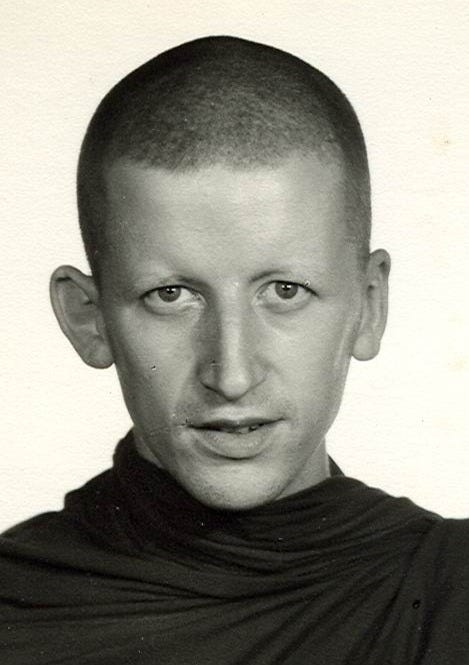
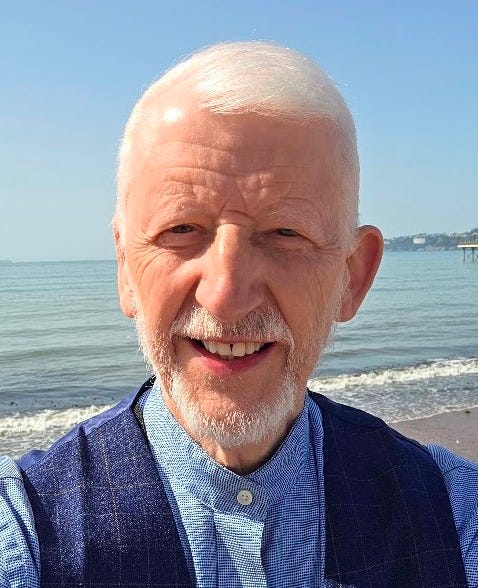
from Kho Phangan to Paignton (near Totnes, Devon). From 20s to 80s.
As a Dharma teacher for five decades that in people’s lived experience, life frequently feels it passes very quickly. One day we look in the mirror and realise we have reached an age we once associated with “old people.” The number can provoke reflection:
“What am I doing with my life?”
“How much time might remain?
“What really matters now?”
Sometimes a small incident triggers this awareness. In India, for example, people often refer to the moment of discovering one’s first grey hair. That single hair quietly announces: “The end has begun to move closer.” I appreciate this reminder. My own grey hairs turned white long ago, so that threshold lies far behind me while death gently whispers in the ear.
Such little signals, when we become conscious of them, make our vulnerability visible. They invite reflection not in a morbid way, but in a clarifying way:
“Given the time I have, however long or short, what do I wish to offer?”
This question can feel profoundly significant. It may unsettle us; it may generate a wave of thoughts and emotions. Yet, rather than dismiss it, we can live the question.
The poet Rainer Maria Rilke wrote in his Letters to a Young Poet that some questions cannot be answered quickly. Instead, we must live the question, carry it with us like a kind of mantra, and let it work on us over time. In doing so, something deep within may begin to move, often in unexpected ways.
When we have developed training in mindfulness of breathing – a capacity to focus, to remain steady – we can apply that steadiness to these existential questions. Then the old formula “I think, therefore I am” opens into something more alive:
“I think, therefore I am… what?”
We do not stop at the thought; we let the question penetrate more deeply into what it means to be human.
Expansive Consciousness and the Mystical Sense
Consciousness, when given full value, stands on equal footing with the material world. Often, through practice or through life’s unexpected grace, we encounter experiences that transcend the purely material. Many of you, in your own ways, have probably known such moments.
Ordinarily, we say, “I’m conscious of you, of this talk, of this room, of these people.” Consciousness seems focused on immediate sensory experience – sight, sound, smell, taste, touch – and on our thoughts and feelings about all of that.
Consciousness reveals far more potential than that.
Sometimes, in meditation or in nature – walking in the mountains, silently along a long beach, sitting under a tree in the countryside – something shifts. The sense of self and world opens. Consciousness and rest of life rests in a vastness far greater than what the five senses reveal.
I should probably add that some encounter an expansion, via ayahuasca, magic mushrooms, and so on. I am not recommending them, but I recognise that people report powerful experiences with them.
In these moments of expansion, there might arise a mystical sense of things, such as a feeling of oneness or a mysterium tremendum.
Going deeper, there is a seeing and knowing of a kind of perception that everything belongs to a single, seamless field. Ultimately we discover a realm without limits.
This does not come as a projection or fantasy. It feels as authentic as the nose that sits between your forehead and your chin. It registers as a direct, vivid, trustworthy realisation..
Yes, the intensity fades. That is the nature of all experiences. Yet something deathless, free and accessible stays steady.
One of the enduring values of such awakening lies in the influence on our sense of proportion. We know the nature of our modest life.
We begin to see:
My life unfolds within something much bigger.
My successes and failures, while important, do not define the great expanse.
Ageing, dying, and death appear less fearsome when seen from that expanded view.
People sometimes say, “I’m not afraid of death.” It sounds very bold when we feel healthy and alive. That view may or may not hold when we face death directly. Others say, “I’m not afraid of death, but I fear the process of dying.” Is the fearlessness true or a conceit of the mind! What is the evidence for the fear or fearlessness?
In any case, insights soften our fear. They show that life moves within a range of conditions and change. They remind us that our individual story, while precious, remains small compared to the immensity of existence. This recognition can bring humility, ease, and a sublime joy.
A Story from Thailand: Birth, Ageing, Pain, Death
Let me share a story from my time in Thailand to illustrate how simple wisdom in ordinary communities can hold these realities.
In 1973, long before the full-moon parties, I spent several months on the island of Koh Phangan, off the coast of Thailand, as a monk. At that time, the island had no proper roads, only tracks. It functioned mainly as a fishing community. I spent nine months living in a cave up in the hills and did not make contact with Westerners during that time.
One day, a young Thai man visited the cave. He worked in Bangkok and had fallen in love with a young woman from New Zealand. She invited him to come to New Zealand, so he sought advice on how to secure a visa and arrange the trip. That conversation did not occupy my usual thoughts in meditation, but we spoke as best we could.
Some time later, while visiting his family on the island, he rode his small motorbike along one of those rough tracks. For reasons that never became entirely clear, he ended up at the local police station and got into an argument with the officer behind the desk.
The policeman pulled out his revolver and fired five bullets into the young man. He died on the spot.
His father, heartbroken, came up to see me with a schoolteacher who acted as translator. The father’s grief poured out in sobs and tears – a devastation beyond words. He asked me to attend the cremation.
Buddhist monks and villagers gathered together. What they did next moved me deeply. In a quiet, respectful chant, they repeated a simple phrase:
Thai - English
Gèrt - Birth
Gàe -Ageing
Jèp - Pain/Illness
Dtaai - Death
They recognised the cycle of birth, ageing, pain and death. Their chanting did not deny the tragedy; it did not avoid the circumstances. The villagers placed the killing in a wider understanding.
The chant resonated. It conveyed a simple wisdom that has lived in those villages for generations. After the ceremony, I listened to the reflections of the villagers and returned to my cave. The consequences for the family and the community continued beyond that day until integrated into the web of existence.
Some weeks later, the father came again to the cave. I asked him, “What happened to the policeman?”
He shuddered. He had seen his son’s body, the bullet holes in the chest and arm. “The senior police officer moved the officer to another police station on the mainland. “The police did not hold the officer accountable, nor met with the family, nor sought justice.”
Mindfulness of the Small and the Vast
When we look closely at life, we encounter both small, intimate experiences and large, dramatic events. An exploration of consciousness invites us to be present with both:
Subtle details of a single breath,
Catastrophe of sudden death,
Beauty of a plant on the windowsill,
Turbulence of global politics.
With awareness and mindfulness, we learn to look carefully at the details – the breath, the heartbeat, a feeling in the body, the shape of a leaf, the expression on someone’s face. In doing so, we do not drift into narrowness; rather, we discover that each small thing contains the whole.
Take a plant at home. We might go for years barely seeing it. We water it, trim it occasionally, move it to the light, but rarely give it full attention. If we sit with it in meditation, really look at the plant – its shape, colour, texture, its response to light and water – something changes.
We feel closer to the plant, and, through that, closer to:
The earth that nourishes the plant,
Water it drinks
Air it breathes
Realm of plant life
Ecosystem in which it participates
Expansive all-embracing reality.
We take one small manifestation of life and discover that it embodies the vast. The one stands for the all.
“Do Not Blame the Lettuce”
In the Buddhist tradition, a simple line has endured for centuries. I try to remember it whenever I hear the name Donald Trump, along with the flood of analysis, opinions, and judgements that many express. That line goes:
“Do not blame the lettuce for not growing.”
If a lettuce does not thrive, we do not react against it. We look instead at the conditions: the soil, water, sunlight, temperature and care given. The lettuce does not represent the problem. The conditions or neglect of them do.
This teaching invites us to adopt the same spirit toward ourselves, toward others, and toward the state of our societies and world. Instead of blaming, we examine the conditions that shape behaviour, institutions, and outcomes. We respond by working to transform those conditions where we can.
A Closing Reflection
Consciousness, when cultivated and respected, reveals our shared life in all its vulnerability and beauty. It reminds us that we participate in something far larger than our individual concerns, and it invites us to respond with wisdom, compassion, and clarity.
Let us take a quiet minute together.
May all beings know the power of consciousness
May all beings appreciate the interconnectedness of all things.
May all beings know a free and expansive view.
oops. typo in part one. Kant not Kan.