

This is a transcribed, edited and adapted talk with extra details included. Given at SeminarHaus Engl Buddhist retreat centre in Bavaria, Germany in July 2026.
A few moments ago, I arrived here in the meditation hall ready to give the Dharma talk. I forgot I removed the SD card from the audio recorder to transfer earlier talks onto the laptop. I am returning to my room for the SD card. Don’t go away. Audio recorder requires dependent arising for the recorder to work.
People sometimes say they are looking for a mindfulness teacher. I have a response. I wouldn’t look in the direction of Christopher. Find a mindful mindfulness teacher.
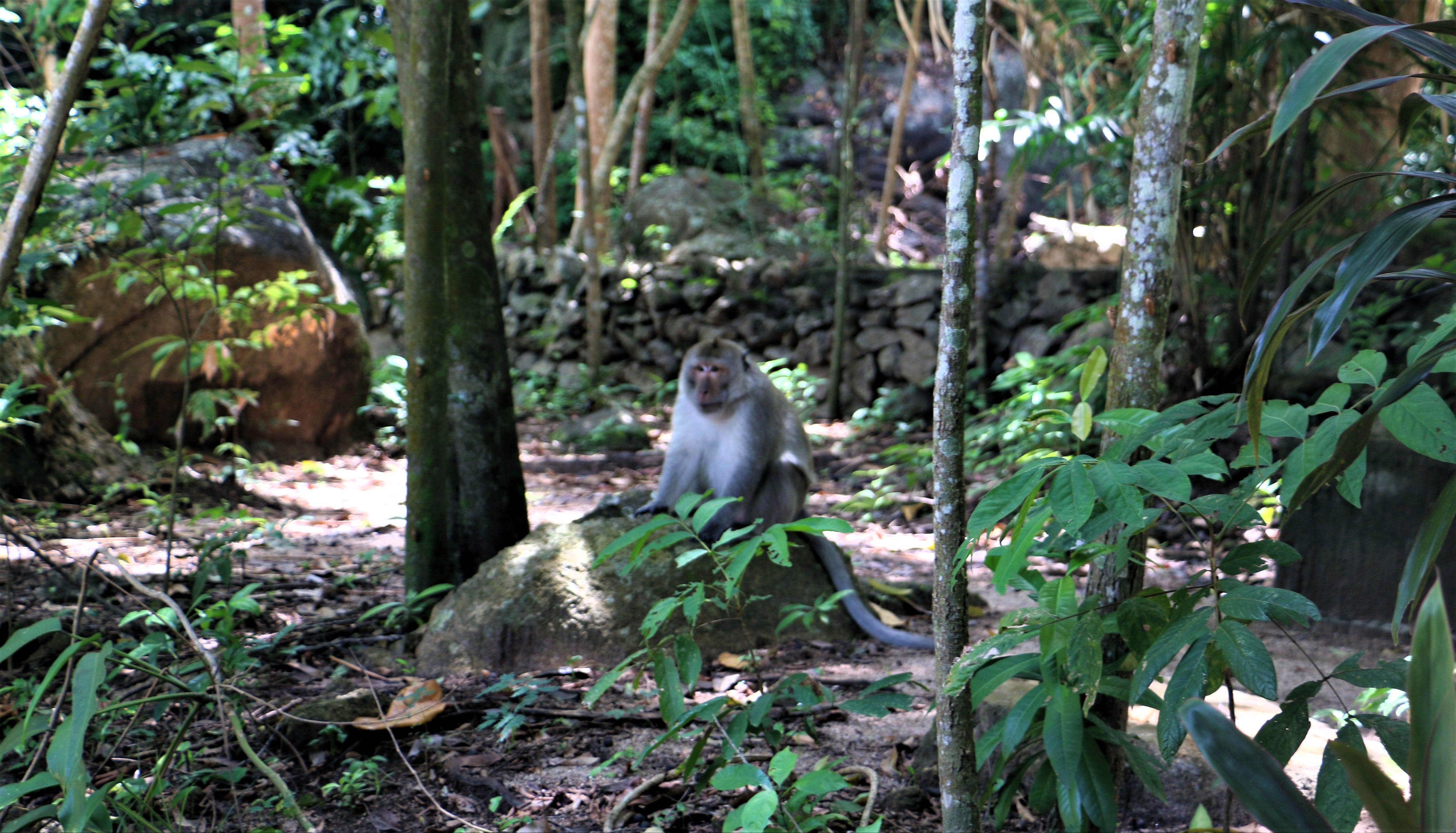
I made a yatra (pilgrimage) to Koh Phangan island in the Gulf of Siam to see my old cave from my Buddhist monks days in the 1970s and also to Wat Suanmoke (Monastery of the Garden of Liberation) in subtripical rainforest. While there, I paid respect to a mindfulness teacher, a long standing ancestor, belonging to the bigger picture. Photo taken in 2017.
Why? Because I belong to a small band of people who know and love the freedom to be unmindful.
In the great discourse that has influenced humanity for some 2,600 years, the Buddha spoke on the Four Applications of Mindfulness—also translated as Four Foundations. In the discourse, he stated, “apply mindfulness to the extent necessary.” Brilliant. I suspect he shares the same view as this wallah. He referred to four primary areas:
Breath and the body.
Range of feeling tones, both worldly and spiritual.
3. Varieties of states of mind, from the profound to the deeply problematic.
Our relationship with the Dharma—not just concepts, teachings, and practices, but the whole Dharma of life and drama of life.
In this sense, everything in the teachings counts as a dharma. Every thought, every object, every snowflake, the world of mind-body-consciousness-matter reveals an expression of Dharma, an expression of the bigger picture.
Nothing else is on offer
Due to cultural and social influences, we notice how much our priority, morning, noon, and night, tries to find and keep a successful self. Social upbringing and powerful voices around us leave a strong residue of impressions. That residue runs like a common thread through education built on competition—those who achieve so-called success, and those who fail in school.
Education rejects diversity of intelligence, rejects neurodiversity, and forces every child and young person to fit into the study/exam/degree regime. Nothing else is on offer. Education promotes year after year a society of success and failure. It is a brutal system, ignoring the natural gifts of the young in multiple ways. Schools, colleges and universities pay lip service to diversity. There is no awareness of the bigger picture.
We live in that culture, whose central focus turns toward the self, with constructions of activity revolved around the self. We try to organise life so that we, as a self, stand as the primary agent of what matters, of what we choose, and of what we regard as success and accomplishment.
We measure ourselves. The measuring turns into a problem—comparing ourselves with others as successful or failures, as winners or losers, as superior or inferior.
We walk straight into a blind spot, barely know anything or have no idea—what lies outside this desire to accomplish, to get to certain goals, to become “successful.”
The whole orientation becomes all-embracing. We think, “I am the agent of what I do. If I work and try hard enough, I can do it.” In that mindset, we forget something. The agent, the creator, the mover, the doer depends on the support of others and on their view of what we do.
We look for approval, craving recognition at home, the kindergarten and as adults. We cannot authorise our own approval no matter how much we think we can. The more we thirst for success, the more attention flows toward our dependency on others—on people who remain unreliable. Our anger boils up experiencing rejection, not getting attention, because we can’t find self-worth in ourselves.
Where is the bigger picture?
Do you see little happiness in your lives? Success doesn’t help; it often deepens the dissatisfaction. You don’t feel fulfilled. The marriage is going up the creek. The job generates stress. Age creeps in, and in latter years, time goes by at a gallop, with death knocking on the front door. There is still no bigger picture.
What does a person do then? There is still little sense of worth, and life drains away as the years go by.
Naturally, a person wants to feel haoppy rather than feeling regular experiences of unhappiness. We look for others in the same state: “Oh, it’s not just me who is miserable and fearful.”
In that pattern, we lose sight of the bigger picture because the mind concentrates in the wrong place. We’ve been told that success means getting what you want. We’ve fallen into the same trap as those before us and around us.
Is a fresh start possible at any time?
Yes. Let’s make that clear. The answer is YES!
A fresh start does not require us to stop our engagement, our work, our daily participation. We reflect:
Can I look at this field of existence in a diversity of fresh ways?
We stay awake until we sense something bigger. Activity goes on. The suffering wrapped around our modest life, along with its issues, can shrink in size. We realise we lost perspective through exaggerating our self-importance. A glimmer of the bigger picture can reveal itself.
Thousands upon thousands of helpers—counsellors, psychologists, social workers, priests, rabbis, imams, meditation teachers—try to support others in dealing with their desires. Sometimes our work helps people to cope with the problematic mind-body process. This confirms a small step sometimes offered by those lacking the bigger picture.
The bigger picture requires honest exploration. Hand on heart, we ask ourselves:
Am I reliant on the approval of other people?
Which person, group, family members, colleagues, voices of authority?
Am I reliant for peace of mind on the views of others?
If I forget my history, my identity, even for a few moments, what reveals?
Pursuit of self-approval and approval from others tires the mind. We can spend our lives trapped in such a pursuit.
One might think: “Fine. I reject others. I won’t let anybody affect me. I’ll stand independent.” That kind of fantasy doesn’t hold. This is magical thinking.
We need a grounded exploration. What stands as our genuine relationship with life—our life and the lives of others?
What about the people we know, the strangers, the unfriendly faces?
Can we hear what gets said, acknowledge what gets written, listen to what comes to our face, what gets said behind our back and stay in touch with the bigger picture? The bigger picture has no marks, no signs, no shape, no sound.
What contributes to steadiness, like a mountain in a storm?
What opens the mind to a bigger view?
What confirms truth as the ultimate steadiness?
Such questions sit in the centre of an intelligent mind.
When we forget, we know the consequences. Self, self, self. Self interest determines thoughts, feelings, moods, relationship to the old and more. Self becomes the confirmation of dependency on conditions unreliable, insecure and changeable. We end up trapped in dependency without meaning to.
Let us explore another way
Why would any sane human being hand over their mind on a plate for someone else to spit on?
Why give another person power and authority, along with the neediness and the hunger for attention that go with it?
Why give authority to your mind to rule your life with its reactive views?
Why lives in the spell and grip of decades of conditioning?
Where is the intelligence in that way of living?
One of our UK politicians, decades ago, had a rare moment of clarity. He described the way to the top in politics. He said: “You either crawl your way or you club your way there.” He ended up leading his political party. Crawl your way: be nice, pursue influiential friends, want to be liked, play the goody-goody.
Club your way: push, fight, crush opposition. There’s someone in Washington DC who chose to club his way to power. I forget his name.
Our UK politician lost the election, a perceived failure. The electororate and media forgot him within weeks. The world often reveals itself as full of shrivelled up situations, due to loss of connection with the bigger picture.
Let’s explore needs in fresh ways to confirm a sense of the immensity of it all. Let us also ensure we:
Understand ourselves, so we can understand others.
Respond wisely to the arising of needs from within.
Recognise the needs of others towards ourselves?
These significant needs means careful reflection and discussion. This serves as a stepping stone to a deeper sense of existence, far bigger than our personal narrative.
We explore the relationship we have with each other. This provides the opportunity to develop cooperation and community.
Life contains uncertainties, the unknown, and sudden shocks that arrive out of the blue. We have to find the capacity to adapt to tje unexpected that can shake us down to our toenails.
The world of name and form
We spend much of our day in what the Buddha called name and form.
I have a name and a form. The form might include “mindfulness teacher,” “writer,” “social critic” “father/grandather” and so on. We carry the names and the forms of our roles. We tell ourselves about our identity.
Sometimes we need to say:
“Let me experiencve daily life including time being free from any burden of name and form.
Let me step into a way of being where my name and form carry no shadows.”
Let me step out of my roles, my job, my knowledge, my training, my information to acknowledge the bigger picture for a period every day.
How many of you know each other’s names here? Very few. How many know the forms of each other’s lives and issues? Hardly anyone.
In the absence of name and form, something else can emerge on a different scale altogether.
During one‑to‑one conversations on retreat, I often see how meditation retreat symbolises the sense of the bigger picture. You come to retreats, perhaps for the first time or joined another one having attended previous retreats. You wish to use the time well, having put aside your name and form (roles, identity, knowledge, personal history).
You attend the meditations from 6 am to 9.30 pm. You use the periods for mindful/meditative sitting, walking standing and reclining rather than staring in the mirror wondering, “What am I doing with my life as I get older?”
The teacher gives instructions for the day. Be mindful. The teacher also says, “I didn’t invent theses teachings and practices. I stand in a tradition of 2500 years with more than 100 generations of practitioners.. They might work for you. See for yourself through your experience.”
Sometimes, I hear something like this:
“Christopher, I’ve done lots of retreats with you, with teachers from East and West. I’ve practised mindfulness of breathing for years, yet I don’t think I’ve ever managed more than three mindful breaths in a row.”
A person can give themselves a very hard time over this. As a mindfulness teacher, let me say this. : it doesn’t matter that much. The breath doesn’t stand at the centre of the practice. The breath gives you something to do—an excuse to show up.
“Be mindful of the breath as it comes in; be mindful as it goes out”—fine. The real event unfolds elsewhere. It unfolds within you, around you, through an unfolding process.
What moves deep in the being matters
Years ago, on a retreat in San Francisco, a sweet woman spoke with me. She said, “I’ve never lived an adventurous life. I have always played it safe. I never left California, never travelled overseas.” She reached her mid-fifties—quiet, unmarried, no children.
“I find it difficult to find my nose, let alone my breath.” Some of you here know this situation firsthand.
She continued: “Last month, I got back from China, where I travelled alone for four weeks. I could hardly believe I did it. I just want you to know that all those meditation practices, all those years trying to be mindful of even one breath, helped me find the trust and courage to go to China.”
In the bigger picture, something more important than focusing on the breath took place. Somewhere in our innocence and not‑knowing, in the silence, the stillness, the meditation process touches us deeply regardless whether we can concentrate on the breath. China, night sky, mountains, oceans, deserts and undulating fields serve as facts and symbols of the bigger picture.
Knowing the bigger picture often shrinks the contracted self, changing our relationship to the world. When that shift grows healthy, wise, and skilful, we can continue our exploration and live expansively.
Sometimes the fruit of meditation, silent togetherness of the Sangha, appears as a sudden breakthrough, a realisation that comes through unexpectedly. Sometimes a deep insight appears quietly, almost unnoticed, that enables us to leave behind our fears. This confirms mindfulness to the extant necessary.
Such shifts matter far more than how “good” you think you are as a meditator. The transformation in daily life carries more weight.
When such an opening appears and we truly appreciate it, an energy arises that never tires. A fresh energy, beyond what we had imagined.
In the senior’s age group—50s, 60s, 70s, 80s—I often hear nostalgia:
“Oh, Christopher, I used to have so much energy. I’d go out Saturday night, party all night, sleep a bit Sunday, then party again Sunday night, and work hard from Monday until Friday. Now, I am in bed by 10 pm every night.”
“It’s age,” they say. Age becomes a mantra. You believe what your mind tells you. You become what you think.
Let us explore happiness, love and aliveness, and develop our senses. Dependency on approval drains us. Dependency on personal views formed from tiredness traps us. A rigid self-image drains us. Complaining, moaning, constant dissatisfaction exhaust us.
Two Precious Encounters at Passport Control
Encounter 1. When I arrived here in Germany last year at the start of a previous visit, I met the passport control officer, who carries a responsibility: deciding who to let in, checking reliability, and so on. Usually entry goes smoothly for people like me.
She asked me from behind the glass, “What’s the purpose of your visit?”
I answered, “To get out of England.”
She looked at my passport: “You come here three or four times a year to Germany for years.”
“Yes,” I said, “because I need to get out of England a few times a year.”
“Why?” she asked.
I replied, “If you lived there, you’d know why.” She smiled. So did I.
I added, “I sometimes think of asking if Germany would offer me asylum. I’m 81. I’m too old to take anyone’s job. I’d be no problem. I would still get a UK pension.”
I enjoyed seeing her serious face soften and smile at this wallah’s sideways humour. An expression of the unexpected sparks a smile that both of us shared. She stamped the passport and I walked into Germany.
Encounter 2. Upon arriving at passport control in the USA.
I travelled to American twice a year for more than 25 years, to serve the Dharma, I had an R‑1 visa, a religious worker visa. I could stay a maximum of three months a year in the country.
Once at Logan International Airport, Boston, the passport control officer asked me with a serious face: “How do I know you won’t disappear into America and not return to England?”
I replied, “I don’t want to live in America. I don’t want to live here because of the racism. I don’t want to live here because of the lack of health service for those with a low income. I don’t want to live here because of the poverty, the pollution, and the violence.
“I prefer to live in Europe. It is healthier, safer and offers far more support to those in need.
“I finish my retreat at the Insight Meditation Society in Massachusetts on Sunday lunchtime, and I fly home on Sunday evening.”
He went, “Oh…” Then stamped my passport and let me into the USA.
Let us not be afraid to express a picture different from officialdom.
Honesty can express a disarming truth
Sometimes, we need to display a little boldness. Not fiction, not aggression—just honesty. Honesty can express a disarming truth but with no guarantee the listener will receive it with a warm smile.
Trust what you do and let that trust resonate with others. Learn from your mistakes.
If your initiatives don’t resonate, never mind. You shared your experience and views with others. How others receive it remains largely their issue, while you take full responsibility for your voice and actions.
Enjoy life. Sense the bigger picture. Be free.
Thank you for listening.
May all beings explore the freedom of the spirit.
May all beings engage with love and dedication.
May all beings recognise the bigger picture.