

In his three short years of teaching from the age of 30 - 33, Jesus spoke primarily of the heart’s liberation through the power of love - a breathtaking vision for humanity.
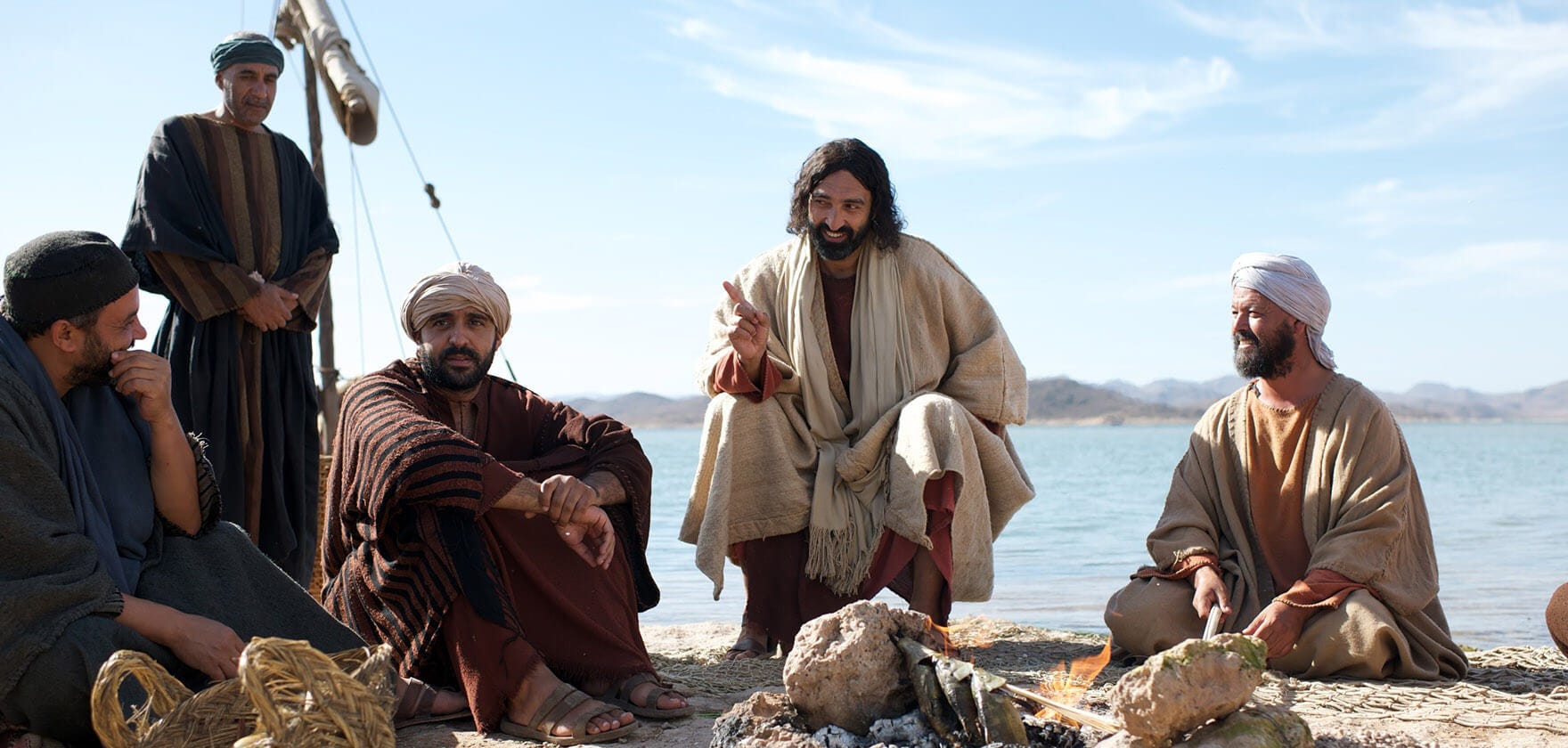
Jesus offering teachings at edge of Sea of Galilee
Despite the Roman military occupation and the daily fears that beset the lives of the Palestinians, they were desperate to listen to profound teachings from a man among them who spoke from his direct experience. No wonder such large and small groups listened to the man from Nazareth.
Born to a homeless, single mother, Jesus probably never went to school, never learnt to read and write. Jesus spoke with a depth that astounded the rabbis, Pharisees and scribes, as well as the rich, the poor, the sick and those with mental health issues.
He enthralled his followers with his stories, lucid explanations of Ultimate Truth (Kingdom of Heaven) and his powerful use of family metaphors, such as God the Father. Jesus made his primary focus to establish the Kingdom of Heaven on Earth - a non-dual teaching of the trancendence and daily life through realisation of liberation and love.
Meaning of the Prayer of Jesus, the hub of his teachings
I have picked out from the gospels a few lines known in Christendom as the Lord’s Prayer (Luke 11.2), the most beloved of all his words a short, poetic statements on ultimate and relative truth.
The Lord’s Prayer captures in a succinct way the heart of his teachings. God represents the ultimate truth and we develop limitless love to bridge the gap between transcendence and daiy life. Not surprisingly, the entire Christian tradition, Catholic or Protestant, liberal or fundamentalist, knows by heart the Lord’s Prayer. Prayer – the Aramaic word is shela – means to ‘incline towards while abiding in a sublime inner space.’ Jesus calls upon us to lead a a meditative and mindful life using the power of prayer.
Like the Buddha and other sages of India, Jesus offered open air satsang (sat – truth and sang, a sangha, a gathering of the ones who love truth). On a hill in Galilee, he offered his listeners a reflective prayer consisting of 52 words, which became known in Christendom as the Lord’s Prayer.
This is the Prayer
“Our Father in heaven,
Hallowed be your name,
Your kingdom come
your will be done
On earth as it is in heaven.
Give us today our daily bread.
Forgive us our trespasses,
As we also forgive those who trespass against us.
And lead us not into temptation
But deliver us from evil.”
Jesus taught people how to pray but in a way different from what they had known. He told his audience: ‘Go into your room, pray to your Father who is unseen.’
For Jesus, prayer primarily expresses the silent repose, the contemplative state of being. In true prayer, there is nothing to ask for. “Do not keep babbling on” said Jesus. Jesus had little regard for long prayers, hymns, religious services, recitations and mantras. “You won’t be heard” because of many words, he warns.
If our prayers fill our minds with words, requests and supplications to God, then the heart is blocked off. “Your Father knows what you need before you ask him.” Jesus said.
In our aloneness, we can forget ourselves; we are not trying to impress others with our presence at a religious service. Our anonymity and our silence provide the open doorway for the deepest truths to come to us. God ‘speaks’ to us in such an inner space. The Lord’s Prayer is essentially a short and powerful meditative reflection into Ultimate Truth and the conventional world, a reminder to realise non-duality in the apparent duality of God and humanity.
Our Father in heaven
The word for Father is Abba in Aramaic (the language the Nazarene rabbi spoke). It means Foundation based on AB – meaning where all movements come to an end, to a completion. Abba is the basis for everything and the completion of everything – in the same way that all waves rise and fall in the Ocean. Jesus fully embodied his teaching right until his last breath on the cross.
Heaven – shem-aya –implies ‘that without limits. It is the Limitless, the Infinite, the Immeasurable, the All (Allah), One in the Many (Eolohim). Truth is one without a second, is immeasurable, out of which the ‘measurable’ emerges, like waves out of the Ocean. The plight of humans is to grasp onto the measurable, onto the waves, and become blinded to the Ocean that is the foundation for the waves. Jesus reminded his listeners of the Ocean.
hallowed be your name
Jesus told his students to make sure they never forget the Father of all things, the unconstructed reality, the Kingdom of God. Let us realise the Sacred, indestructible, without beginning, middle or end, free from characteristic features while making everything possible.
your kingdom come
He encouraged his students to focus their lives on realising the Kingdom of God that lies in the immediate heart of all things. We live in the conventional world of the nation state; kingdoms that endeavour to co-exist or dwell in conflict with each other. Jesus pointed to the borderless Kingdom.
your will be done
In this fourth line, Jesus introduced non-duality into his prayer as a statement of deepest intimacy with liberating truth. It is the inseparability of ultimate truth and relative truth, of the transcendent and the ordinary. In family language, the prayer integrates God the Father and God the Son.
Jesus reminded everyone that our spirit matters. In the Gospels, there are more than 100 references to the spirit – ruha – the word also means breath, air, wind. Jesus told his audience the importance of breath as a vehicle to bridge the link between God and ourselves.
on Earth as it is in Heaven
Jesus warmed even more to his noble theme by ending the gap between heaven and earth, between Nirvana and samsara.
Give us today our daily bread
At a deeper level, bread means that which nourishes us. When we abide in inner silence, we can turn towards the transcendent principle. We make ourselves available daily for ultimate insights and revelations, uplifting our spirit and releasing joy and deep inner peace. This is the bread of life.
Forgive us our trespasses
Forgiveness enables a return to our true nature of depth of integrity, free from selfishness and blame.
As we forgive those who trespass against us
Again, Jesus called upon us to dissolve the differences between each other. We blame ourselves for the way we engage in unwise actions. We inflict anguish and sorrow on others. Jesus reminds us of our capacity to love even to those who trespass against us, harm us. With presence and love, we take away their power to make us fearful, angry, and burn up within.
And lead us not into temptation
Jesus and Buddha reminded us that even when established in the foundation of all things, temptations may still arise.
And deliver us from evil
Evil includes the deliberate intent to inflict suffering upon others. The Lord’s Prayer makes us available for the most profound of realisations. In the space of about 50 words, Jesus captured with exquisite sensitivity the heart of all spiritual teachings.
It is one of the greatest statements of truth ever uttered ranking alongside the precious, brief statements of the Buddha.
In 10,000 discourses, the Buddha made a single reference to the next Buddha who would be known as Maitreya Buddha - the Buddha of Love. of Friendship, of Kindness.
The name of the Buddha of love would spread throughout the world. 500 years later, Jesus was born.
I do not see the evidence to confirm we are all Buddhas of love., inwdarly or outwardly. If it is true, there is nothing to be done. Apologies. I could not follow the words with the ? love Christopher
Are'nt we all Buddhas of Love, The delivering force if ever there has been ONE?