

Is Meditation Necessary?
Transcription of part of a Dharma talk in early August 2026 given in a retreat in the Waldhaus Buddhist Zentrum, near Koblenz, Germany. This is an edited and adapted version of the talk with significant additional points.
Is meditation necessary? Is it an indispensable Dharma practice?
It is important to remember the Buddha emphasised the transformative power of listening to the teachings, followed by reflection and lived inquiry to affirm liberation. He encouraged those who did not come to realisation and liberation through listening to engage in the process of meditation. Meditation contributed to two important features, calm and insight.
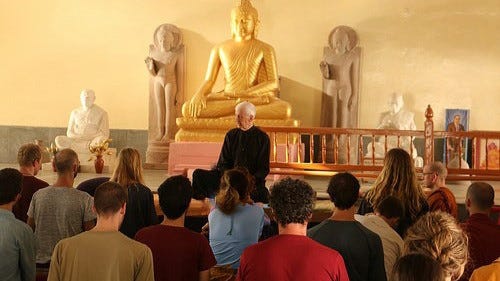
Serving the Dharma. Thai Monastery, Sarnath, near Varanasi, India. 2018
In the time of the Buddha, people in north India referred to his Sangha as shravakas – the ones who listen. The 10,000 discourses of the Buddha confirm far more came to liberating realisations as shravakas than any other way, including meditation.
Remember: meditation practices can help overcome unwelcome tendencies. This nourishes the being through the depths of meditation, revealing for some love, joy, and wonder. These experiences do not constitute liberation but reveal the potential of the mind to know experiences free from dominating tendencies.
Otherwise, we might conclude, “I’m nothing but tendencies,” and then form a new tendency: obsessing about tendencies. The temporary absence of latent tendencies gives us a precious taste of freedom, like the taste of a dewdrop of water at dawn. It has the same taste as drinking a litre of water.
Meditators ask me: “How important, central, or necessary is meditation?”
Remember, a meditation teacher responds to your question. Please allow for any bias, a common tendency, in the response.
Two Primary Forms of Meditation Experience
The Buddha-Dharma offers expansive and generous teachings and practices. I’d like to make that clear.
1. Calm leading to four deep meditative absorptions (jhāna)
Meditation can go deep, touching states of absorption that bring happiness, fuelling mind and body in beautiful ways. Second, meditation can go deeper into refined joy and third deeper into mindful equanimity and fourth a profound inner peace with resilience. In such depths, our being becomes steady like a mountain in a hurricane. These subtle states of meditation offer a precious journey to contribute to receptivity to teachings of wisdom and liberation.
However, deep absorptions do not stand as a prior requirement for a liberated life.
2. Insights arising from meditative awareness and clarity
The kind of practice we mainly use here on the retreat: mindfulness, awareness, the power of attention, seeing clearly. This may or may not lead to deep absorption. We come to insights about the presentation of our persona, the movements of self/ego and insights into the lived experience. The infinite range of insights can bring much clarity and understanding.
In the first part of this talk (see the previous transcribed talk), we learn that latent tendencies do not depend on deep meditative states of calm. Insight meditation employs clarity and careful examination to see tendencies, gain understanding in the process of freeing the mind up so that these patterns no longer oppress our daily life. That movement itself certainly confirms a liberating quality, a reflection of liberation.
In insight meditation, we may give priority to:
· the impermanence of phenomena,
· awareness of suffering and unsatisfactoriness,
· seeing of self as a manifestation of conditions
· not seeing self as a cause nor a controller of events.
Four Formless Experiences
The teachings also speak of four formless realms:
Formless experiences don’t count as “absorptions” in the technical sense. The formless belong to an expansive realm.
For instance, you might experience (not momentarily, briefly) a strong sense of infinite space. That sense of boundless space, of cosmic wonder, can also reveal within. We sometimes say, “I feel really spacious today” - a sweet whisper of infinity wthin. Another person may notice this in us. Infinite space embraces inner and outer.
Spaciousness expresses an opening of the heart, a loosening of narrow, contracted views. This openness hints at a potential manifestations of liberation.
Second. Consciousness can expand into an infinite sense. Infinite consciousness means that not only do you feel truly alive but sense that everything around feels alive as well —the sentient and the non-sentient. Life/consciousness appears vivid, vibrant, pervasive. These deep experiences can arise through meditation or spontaneously.
We also need openness to a range of spiritual, mystical, religious, hard-to-explain experiences. Tremendous wonder can come through the small human being. We walk around as little “children of the universe” with tiny eyeballs. The eyelid lifts and we go, “Wow!” as we witness the expanse of the universe and deep inter-connectedness. The experience may fade but can leave a change of view of life.
Third. In these realms, we experience no-thingness, a profound undifferentiated absence of seperate things revealing interconnectedness .
Fourth. The first three depend on percpetion. The fourth realm reveals the insubstantiality of solid perceptions and the perceiver that accompanies the perception.
There is no such thing as a brief touch of the four absorptions or four formless realms. Your mind cannot move up and down between either of the four. In the deep, movement is vary subtle. Refinement of awareness, silence and stillnes serve as aids.
These “wow” experiences offer a depth far more significant than the trivial pursuit of pleasure and status. In spite of the depths of absorption and realms available to us, wisdom and liberation may still be hidden or mostly reduced to intimations.
When Experience Doesn’t Match the Ideal
Yet, despite all this, meditators tell me:
“I’ve done a lot of meditation. I’ve heard about deep absorptions of happiness and joy but never achieved any. I remember I had a smile on my face after one of your funny stories, but nothing more than that.”
Infinite space and cosmic aliveness? I joined a ayahuasca cereomy and mostly remember vomiting into a bucket.”
People sometimes feel let down by the absence of such experiences. They think, “I must be doing something wrong. I have these as stepping stones on the path. I am not sure I am on the spiritual path. “ Such views causes doubt.
These experiences do not form a checklist for genuine practice, nor for liberation.
If you don’t believe me, check the suttas (discourses of the Buddha).. Don’t rely on my voice.
Listening as the Primary Vehicle for Transformation
The texts support another point: the primary vehicle of transformation has not been meditation. That may surprise some, but historically, the main engine for change has come from listening.
Listening plays the central role. In listening, the words can wake up the human being, even if they don’t stay in memory. Teachings of deep Dharma can spark a deep response. That spark reduces the authority of tendencies, sometimes dramatically, liberates the mind and reveals a wisdom in knowing a sense of an ultimate truth beyond impermanence, suffering, big or negligible, and non-self.
People loved and respected the Buddha because he spoke the deepest Dharma. Two and a half thousand years later, his voice still echoes in the meditation hall, in recorded talks and podcasts.
The Buddha made clear his approach.
First, one listens.
If deep understanding does not immediately arise, one reflects.
If reflection still doesn’t bring a deeper shift, one inquires—talks with others, asks questions, explores.
If that does not bring a liberating wisdom, one meditates on the theme, bringing more awareness to it.
If that not work, then one meditates for calm and insight to resolve problematic latent tendenceies to maximise receptivity to wisdom and liberation.
The initial aim does not involve chasing special meditative experiences to confirm the teaching; rather, meditation can clarify the teachings so they take root in being.
Practice Without Formal Meditation
With regard to tendencies, a practitioner could explore everything said without ever sitting on a meditation cushion. The practice would involve:
· Investigating tendencies,
· Noticing the time, place, circumstance of its arising
· Seeing where and when they arise, stay and pass
· Developing impermanence to support letting go of the changeable and unreliable
· Reflecting after encounters.
None of that depends on a particular posture.
That shows the generosity of the teachings: meditation forms one part of a larger body of Dharma yet from from dependency. The Buddha spoke of the “body of teachings.” Meditation belongs within that body, but much else does not fall under meditation at all.
Meditation does not cause liberation. If meditation caused liberation, I would feel duty-bound to maximise meditation as the cause and make everythng else secondary But that view cannot hold. It would lead to a tragic narrowing of the body of the Dharma. Some meditators cling to the view:
· “Only through meditation can you get liberated.”
· Then, “Only through sitting; not walking, standing, reclining or daily life.”
· Then, “Only through sitting employing this particular technique.”
That progression shrinks the path to something absurdly contracted. How could a human know liberation while identifying themselves with such a narrow mindset?
A View of Meditation
So, I wish to speak as independently as possible.
Meditation holds genuine value.
Meditation has power, preciousness, and will influence life deeply for many.
Yet full awakening, a truly liberated life, can unfold without any formal time on a meditation cushion.
I say this because I know people who live with extraordinary wakefulness, little in the way of tendencies. Some used to engage in formal meditation practices alone, with others or on retreats. Others with much wisdom have not even thought to search a website for the word “meditation.” I bow down to such people.
We need to keep an expansive view. If meditation serves you and you find it deeply beneficial, then use it. Make use of retreats, teachings, and supportive environments.
May this retreat prove beneficial.
Closing Blessing
May all beings recognise and appreciate the times when tendencies fall away, and what those absences reveal.
May all beings dedicate themselves to dissolving tendencies for the welfare of life on Earth.
May all beings move toward waking up to liberation and wisdom—with or without the support of meditation.
Thank you for listening.
This is a great article Christopher. So clear and expansive in its outlook. I
Dragging fucking ed Sheeran in to lecture us on fucking morality is beneath contempt in my view