

We have time or we don’t have time. Why do we have time and then we don’t have time. Does the idea of “having” confirm a misperception? Meditate on this. Reflect on it. See the emptiness of holding or having anything or anyone, including time.
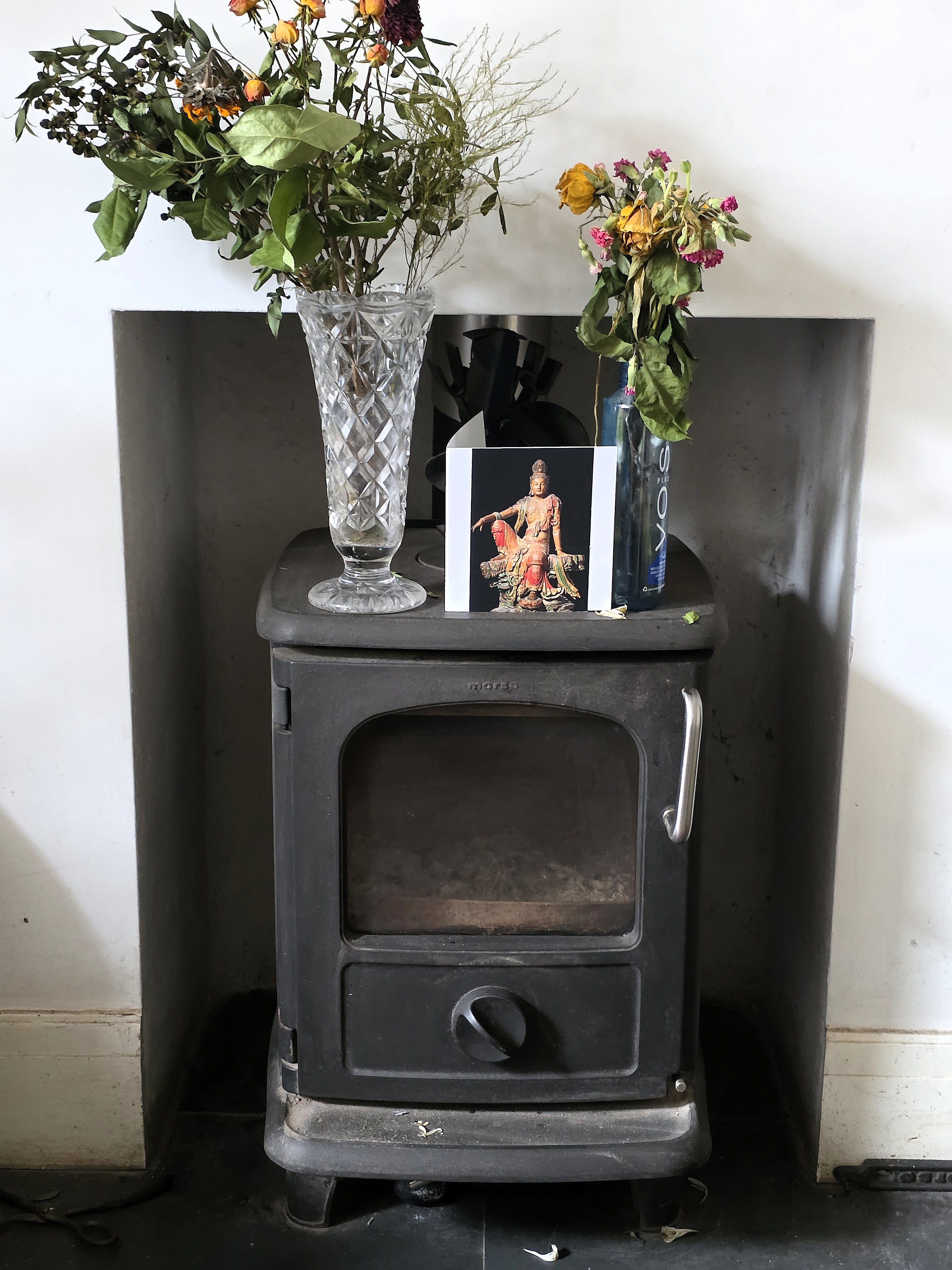
In early September 2026, D’nae, my grandaugher, kindly bought me a bunch of flowers. Two friends from Switzerland visited and gave me a bunch of flowers and the card. Then the flowers displayed the beautfy of their subtle colours that we love to see in their quiet power to brighten a room. Time goes by. Flowers go on to offer a teaching in the silence as they change from day to day. They arose, offered happiness and faded. Today the flowers join the compost. Meanwhile, the Buddha mind stays steady amidst the changes.
We cannot hold on to a single moment.
Holding onto the past obstructs the capacity to see with clarity the present and future.
Holding onto the present impedes seeing the past and future clearly.
Holding onto the future, keeps us out of touch with the past and present.
First hand experience confirms an unfolding process of change, inwardly and outwardly.
Views of the content of the past, present and future undergo change in gross and subtle ways. We don’t find this easy. We want things to change that do not seem to change. Then, we want things to stay the same, but they change.
It’s a fact that we face daily. It takes clarity and wisdom to live with this unfolding process without suffering over it.
The belief in having and holding onto paves the way to suffering regardless of whether you think the content of interest or the views are good or bad, right or wrong. You can suffer over the good as much as you suffer over the not-good, the bad, the evil. Human problems relate to what did arise, is arising or will or might arise.
Idioms to time
Idioms are phrases and meanings not in the literal words, such as time. These phrases can evoke stress, anger and powerlessness.
We carry idioms around time. Repetition of the idioms makes time a commodity.
Having time,
Not having time,
Making time,
Wasting our time,
Life is short
Our projections impact on our concept of time. The impact makes time into a substantial reality, instead of a useful tool for application. Investment in our views of time leads to stress, anxiety and reactivity towards ourselves and others. Time is not problem, only a useful social construction.
What are ways to look at time without stress?
We measure the value of ourselves through the ways we spend our time. Our view of the use of time does not depend on time but on our perceptions, views and mood at the time and projected upon time. That means strees refers to the view of time, not to time. What is a non-stressful view?
Our relationship to time may reveal a similar relationship to money. Bring clarity to time might bring clarity to money or something else. After all, it is the same old mind that lands on both.
Three areas for reflection
Consider conventional time. Such time consists of numbers – second, minutes, hours, days, weeks, months, year and more. A useful measurement often agreed upon including different time zones.
Time in the mind. Idioms around time reinforce measurements of time due to investments by the self. We can experience a string of approval and disapproval of others or ourselves in terms of time. Examples include arriving early and arriving late, completing tasks on time and not finishing on time.
Can we liberate time from the pressure we place on time? Repetitive thoughts about time also impose a sense of reality on the insubstantial views and numbers (time, date) involved.
Here is a modest list of common reactions around time. Other languages refer to time in diverse ways.
Reflect on two questions and two responses in mind
1. What idioms around time do you often use?
2. What is an alternative way of saying the same thing, free from a reaction inferred in the idiom?
3. Write out the alternative and apply daily.
4. Experience the benefits.
Sixteen common idioms affecting the state of mind.
“Don’t waste my time.”
“Have you got time for a quick chat?”
“I am pressed for time.”
“I can’t find the time to write.”
“I don’t have time to read it today.”
“I have too much time on my hands.”
“I need some time to think.”
“I spend far too much time thinking.”
“It was a complete waste of time.”
“Please make time for yourself.”
“I devote all my time to my family.”
“Take your time — there is no hurry.”
“That shortcut will save us time.”
“There are not enough hours in the day.”
“We are short of time.”
“We need to save time.”
Time involves what did arise, what is arising and what might or will arise.
Jewel of the Timeless
The jewel of life confirms the timeless, unbound to past, present and future. Freedom confirm the timeless and the other way around.
Timeless puts into perspective the constructions revealed as manifestations of time.
Timeless confirms the wonder of the great expanse, not tied down to anything, including sun, moon and earth used to measure time.
Do you know firsthand whispers of the timeless?
A single note of music confirms the timeless.
Love
Christopher