

Sam and I shared a two hour exploration addressing areas of common interest and posted the link on his website.
I received emails responding to our dialogue. Suscribers to Sam’s website have been present on every residential retreat in the past two years or so. Perhaps this imdicates an interest in spirituality, the depths of meditation and awakening, which Sam strongly encourages.
In Part One, themes included time in the East, path-goal, non-duality, Poonja-ji, Sam’s book, secular rationality, Muslims, prayer.
Born in 1967, Sam Harris is an American neuroscientist, author, and podcast host. His works have emphasised belief in secularism, rational thought and neuroscience. His books include The End of Faith and Waking Up (2014).
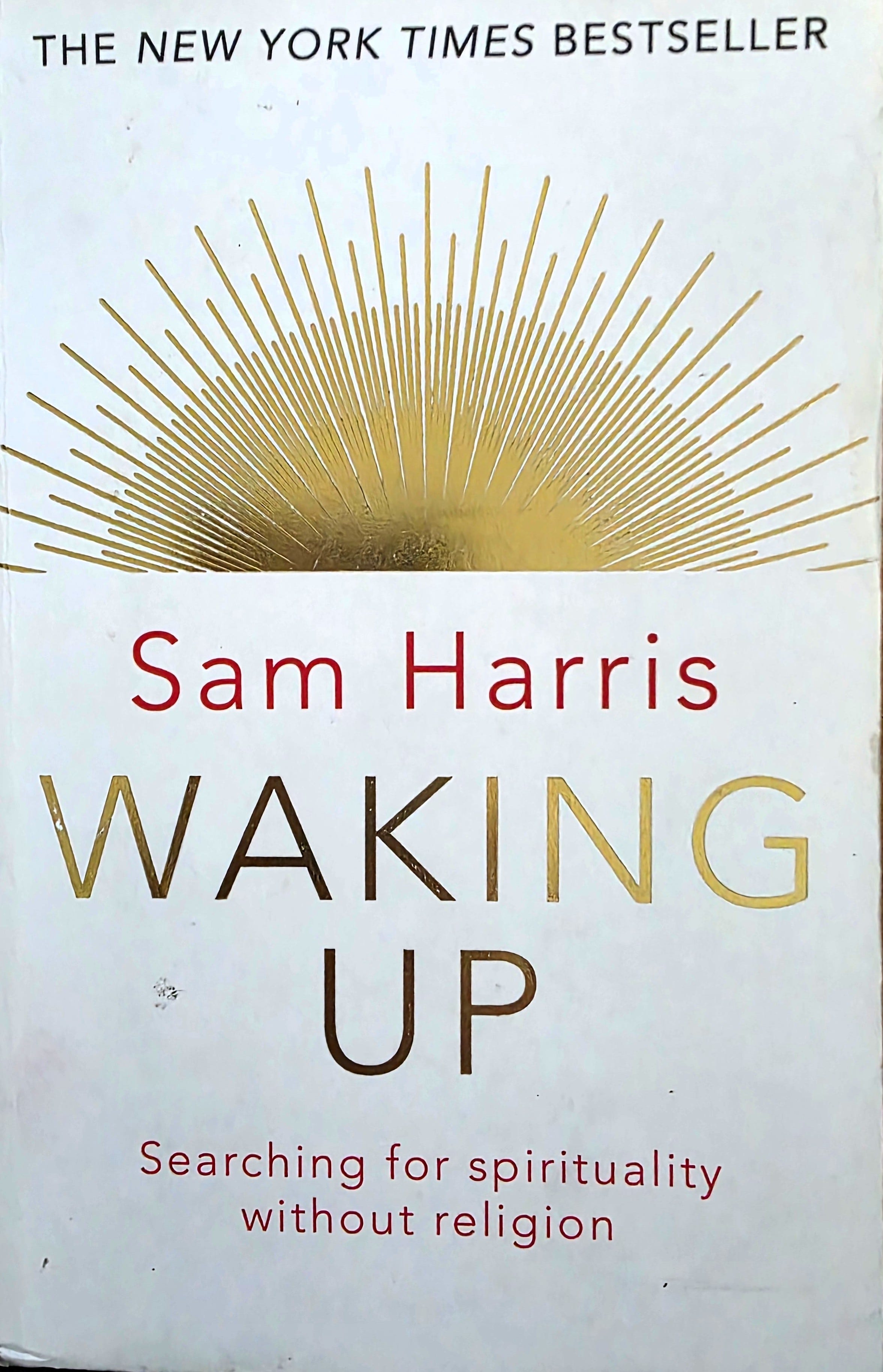
Along with its title, the latter book recognises the influence of the Buddhist tradition, significance of spirituality, non-duality and his personal experience. Chapters include Buddhist themes found in the three major traditions of Theravada, Mahayana and Zen. Titles of chapters include Mindfulness, The Truth of Suffering, Enlightenment, Consciousness without Self and Gradual verses Sudden Realisation. On the back jacket, senior Buddhist teacher, Joseph Goldstein recommends the book.
The recording has been transcribed into text. For readability, I edited the text, tightened sentences while keeping to the themes and tone of a cordial meeting. I added points to support the reading experience. For ease in reading, you will see 11 themes under Headings addressed in Part One.
HEADINGS
Questions from Sam to myself of start of my journey
Buddhist monk ordination and time in Thailand
Time in India as a Buddhist monk
Emergence of Poonja and Andrew Cohen
Path to Goal and Non-Duality
A Guided Meditation
Response to Sam’s Book Waking Up
Does a conviction for secular rationality and rejection of religious beliefs reveal a blind sp0t?
Experiences of Muslims, religions and society
Religious Belief and Prayer
What shows genuine support without a religious or secular stance?
Part One. A Summary
Sam and Christopher trace Christopher’s journey from Roman Catholic childhood through six years as a Buddhist monk, including ordination and practice in Thailand, extensive spiritual/religious exploration in India, and work with figures in Thailand and India such as Ajahn Buddhadasa, Ajahn Dhammadaro, Sri Nisargadatta Maharaj and Swami Dayananda. He explored path and goal, non‑duality, and the limits of guru‑centred communities. A guided meditation introduces the liberating middle way. He gives priority to freedom from identification with path, goal, spiritual identity, to uncover liberation through seeing the emptiness of the ego.
SH: I am here with Christopher Titmuss. Christopher, thanks for joining me.
CT:: Thank you for the invitation.
SH: I know we know many, many people in common, but we’ve never met. I’m surprised to have never been in the same room with you. We have travelled similar paths for, for many, decades. We can start with the beginning of your entanglement with all things related to meditation and the dharma, and questions around the nature of the self, the nature of consciousness. When did all this start for you?
CT:: It started rather early. I’ll keep this reasonably brief. I was brought up by a single mother in early years of my childhood. She was a devout Roman Catholic. So Catholicism strongly influenced my childhood. I had a Catholic education.
In April 1967, I began travelling overland. You were born that month. This journey later became known as the “hippie trail.” It took me through Europe, Turkey, Afghanistan, Pakistan, and India. After about three years on the road, something shifted. In 1970, I took ordination as a Buddhist monk in Thailand. That was triggered by an interest in meditation, as you asked.
There were also experiences from smoking joints and more on the road. These, and other things, opened the sense of an inner journey. I developed an inner journey rather than just external travelling.
I had the privilege of six years as a Buddhist monk. About three or four of those years were in a Vipassanā (Insight Meditation) monastery. We share many friends and contacts in that tradition.
In the monastic life, we lived largely in silence. We were encouraged to practise outdoors under trees. The Abbot could see us meditating in all four postures. Sitting, walking, standing, and reclining.
From there I went to a cave on Koh Phan Nga Island. Later I spent two years travelling in India and Sri Lanka as a monk. I went from north to south India, across the country.
That allowed me to explore Hinduism and Advaita Vedanta. I met the non‑dual teachings that I know you appreciate. I also encountered much more, including Tibetan traditions.
After that period in the Far East and monasteries, I disrobed and kept travelling. to the Far East, to America and eventually returned home ten years later in 1977.. Then teaching began, in various parts of the world. That’s the brief version.
Buddhist monk ordination and time in Thailand
SH: Were you with Buddhadasa the whole time you were in Thailand?
CT:: No. He was a major influence. I stayed with him for varying periods in his forest monastery from weeks to months, where he lived for 60 years. In February 1970, as a hippie, traveller, deeply interested in Buddhist practices and meditation. I had many questions when I paid my first visit.
The Ajahn said to me:” If you want to understand all of this, (in my life, they’re immortal words), you can’t identify, cling, or hold on to anything.”
In a symbolic gesture of this, he took hold of his robe. pulled it off the shoulder and made a precious one-line statement.
“Nothing at all is worth clinging on to or being identified with, including the idea ‘I am a monk.’”
That opened my eyes up. I ordained weeks later. I had many more precious exchanges with him in the years ahead.
SH: Nice. Did you study with Ajahn Chah as well? Did you know Jack Kornfield from that period?
CT:: I did. I didn’t study with Ajahn Chah. I first met Jack when he visited my monastery. The monastery of Ajahn Dhammadaro, my Vipassana (Insight Meditation) teacher, is based in the south of Thailand, a 16‑hour train journey from Bangkok. Ajahn Buddhadasa, a teacher of emptiness of self and dependent arising lived around three hours north on the train.
Time in India as a Buddhist monk
SH: Now, what about your time in India? When you say you got exposed to Advaita teachers, did you make the rounds of the prominent gurus?
CT:: Yes, During the pandemic and the lockdown, I dug out hundreds of letters, 40 diaries, and notes, etc. I had the privilege of meeting with many gurus - Sri Nisargadatta Maharaj, Krishnamurti, the Dalai Lama, Osho, Swami Chinmayananda, Swami Dayananda, Mother Teresa, and many others, as well as Advaita (non-Duality), plus teachings of the Tibetan tradition, Christian biblical studies and more. I stayed several months in Dharamsala and attended classes in the Tibetan Library in late 1974/1975, In much of the Tibetan tradition, there is a deep devotional element. That’s not my cup of tea. I gave my first 10-day retreat in McLeod Ganj, near Dharmasala, home of the Dalai Lama.
SH: Famously in Buddhist circles, you have given retreats in India, in the Thai Monastery, Bodh Gaya, close to the site of the Buddha’s enlightenment. When did you start doing that? Have you done that every year?
CT:: I gave retreats every year in India for 48 years including 20 years in Sarnath (where the Buddha gave his first teachings) until the Covid pandemic. Kindly, the Thai abbot of the Royal Thai Monastery in Bodh Gaya invited me to teach internationals and from India due to being a member of the ordained Sangha at the time I offered the first retreat.
This may not be your cup of tea here, Sam, but I co-founded, with the help and support of others, an inter‑religious school in Bodh Gaya. We started off with 20 kids in a room in a monastery, and that gradually expanded.
I didn’t want a Buddhist school. I’m not a Buddhist myself. Our school reflects diversity, with mutual care and respect between Muslims, Hindus, Buddhists, Christians and those with secular values.. That’s the ethic within the school.
Our school, Prajna Vihar School (School of Wise Abiding) with 500 children offers yoga, mindfulness, meditation practices, the arts, dance, street campaigns, environmental awareness and more. Head teacher is a Roman Catholic nun. Teachers are of different faiths are trustees. Some of the children, who were beggars on the streets of Bodh Gaya, have gone onto university.
Emergence of Poonja and Andrew Cohen
SH: I recall the sudden emergence of Andrew Cohen on the scene (in the mid-1980s), preaching the gospel of Advaita and its timeless superiority to all other approaches to practice. I felt like that landed in your world, collided directly with your world, where you were teaching in Devon,England at Gaia House. Was that right? Were you at the beginning of Andrew’s time when he started teaching.
CT:: Yes, Andrew was a sincerely dedicated meditator. He sat retreats with various teachers, including myself, including Gaia House retreat centre in Devon, UK, near my home in Totnes. He also attended my retreats in Germany, East and West Coast of the USA and in Bodh Gaya.
After one of our retreats in India, he took the train to Lucknow to attend satsang with Poonja-ji, who I know you met. Andrew joined several others from the retreat. Andrew had a number of experiences under the wing of Poonja-ji over several weeks. Poonja-ji spoke very highly of him, as Poonja-ji tended to do with many people. He made Andrew an Advaita teacher. Andrew came to Totnes and made contact with some dharma people, of course, who I knew. This helped to initiate him as a teacher.
SH: Did you ever go to see Poonja-ji yourself?
CT:: Yes, I did indeed. So I first heard of Poonja from friends. We were communicating together, that means writing a letter. I invited him to come to the Thai monastery to give a talk and have a satsang with the group. He was unable to come; he had some foot issues, and walking was rather difficult for him. So I said, “I’ll come to see you.” So we had some time together in Lucknow.
SH: What was that like? Were you impressed by him?
CT:: I thought he was precious. His skilfulness, warmth and perceptiveness, reveaaled his faithfulness to non‑dual teaching. I saw the benefit for many including good friends He made an important contribution to the questioning of the duality of path and goal, which the Buddha and Buddhist tradition often focusses on. That duality has a function, but also can become an impediment. The self constantly measures itself on the path: Am I close to the end? Am I far from it? Am I going deep? Advaita, to its everlasting credit, questions such a duality.
I also had a concern with Poonja-ji; he would speak extremely highly of people, including myself and others, in glowing terms of their realisations. Some of those people spent a short period of time with him, a matter of weeks or ta couple of months. I regarded such penultimate praise as unwise.
I encouraged people to listen to Poonja-ji’s teachings. Some grasped his spiritual praise for their realisations and they made an identity out of it. That led to problems for themselves and for others.
SH: I share that concern.
CT:: Yes. I saw you referred to it.
Path to Goal and Non-Duality
SH: In light of all these influences and your long experience teaching people and guiding people between these two “half‑truths.” There is one side a dualistic conception of path and goal. Everyone starts out far from the goal. On the other side, there’s the totally uncompromising non‑dual message that there is no path and there is no goal. You are already enjoying the mind of the Buddha if you can only recognise it. Somewhere between those two conceptions we try to marshal the skilful means to help ourselves and others awaken and remain awake. How do you think about the path and the goal and this concept of freedom at this point?
CT:: A personal question or a general one, or both,
SH: However you want to take them.
CT:: Thank you. The language of path and goal serves the person with a sense of direction. A person says “I do my practice, I meditate, I develop ethics, I cultivate an expansive heart.” The body of teachings go in a certain direction. Practitioners know they are on the path.
The identification — “I am on the path” — can become problematic. The other view — “There is no path, there is no goal, it’s only now, you’re already enlightened, you’re already in the goal” reveals another problematic viewpoint. A human being may hear that, read about it, and believe it. It does not mean the person knows a deep transformation.
The middle way neither grasps onto the path and goal nor swings to the other extreme saying, “We’re already enlightened, well, this is it,” etc. It is liberation from not being ensconced and caught up with two particular viewpoints.
SH: How do you teach people to recognise that middle path? Could you offer me a guided meditation I’m concerned about those listeners who have a clear sense of what mindfulness/meditation is from the dualistic path‑and‑goal position, but they may find any claim about non‑duality or the illusoriness of the self perplexing. They find themselves struggling to understand: what is being claimed. That consciousness is already free of self, or free of this notion of centre? So, how do you instruct someone to pay attention without falling into either of these extremes — of identifying with the problem or the meditator who is solving a problem or identifying with the conceptual assertion of there being nothing to do and no one to do it?
CT:: There are two ways to approach this. You and I could explore this. I’ll ask you some questions. That would be one. A guided meditation can provide an effective tool, to go deeper. much deeper or a reflection. So, what would you like — one, the other.
A Guided Meditation
SH: I’m happy to do either. Let’s do the guided meditation. You can place any questions you want in that meditation. Listeners can’t respond with questions to you. What will you tell the audience to do with their attention.
CT:: Five minutes, 10 minutes?
SH: Do five minutes or 10 minutes..
CT:: Bless you. Let’s sit. two feet firmly on the ground, backside in contact with the chair. We sit, tall. A human being abides in the silence,
SH: A certain stillness.
CT: (A sentence is followed by a pause for 20 - 30 seconds or so).
“There is this immediacy of experience, of a silence and the stillness of the whole being. The words of Christopher pass through the silence.
“Let us leave behind all our “accumulated history”: “I am, I was, I did, I know, I experienced.”
Right now, the history of our decades on this earth are absent from consciousness.
Our roles, identity, and gender and age have no relevance.
We are neither religious, spiritual, secular or science based.
These four primary categories to show four ways of interpreting life, for better or worse.
In this temporary absence, we know the absence of wanting to achieve a goal in mindfulness, in meditation.
There is also an absence of “I am already enlightened. I have achieved the goal.
No constructs abide in the mind.
Is there an opportunity here for depth — a freeing up, an emancipation of the human being?”
SH: Nice, nice.
Response to Sam’s Book WAKING UP
SH: Well, so do you want to engage in the question‑based mind? I’m happy to play.
CT:: I read this interesting book that you wrote. There is an invitation on the cover of your book with its title Waking Up. Sub-title. Spirituality without Religion. I don’t have a religion, so I don’t have any indentification with a religion. I wonder. The subtitle of your book Spirituality without Religion looks dualistic. Sam, What’s your response?
SH: I guess at that level it is. I mean if we’re going to talk about absolute and conventional reality…
CT:: All right.
SH: It’s definitely a conventional‑reality, culture‑war point I’m making, to disavow religious orthodoxy in favour of scientific rationality and secularism.
My argument is really that even if all of our religious traditions are in possession of some core truths that we don’t want to lose — i.e., there really is a baby in the bathwater we don’t want to throw out, as I think there is — still, the best description of those truths has to make reference in the 21st century to all that we understand about the nature of the human mind in a non‑sectarian way.
So I guess the short way of saying this is that whatever is true about the human mind at bottom, those truths are going to have a non‑sectarian description. In the same way that physics, even though it was invented or discovered principally by Christians, it would be ludicrous to talk about “Christian physics,” right? The moment we had physics, we saw that it couldn’t be Christian, it couldn’t be English versus American. There’s just one physics.
And if there are spiritual truths to be discovered about the nature of the mind — I use the word “spiritual” somewhat sheepishly and in rare quotes — but if there are profound insights to be had from the first‑person side through a practice like meditation, as I think there are, these are not Christian, they’re not Buddhist, they’re not Western, they’re not Indian; they’re just the universal potential of human minds everywhere. We need to discuss it in those terms.
Hence my disavowing religious orthodoxy and sectarianism.
CT:: I appreciate the good points you make. Listening to you, the phrase “without religion” sounds absolute. In your book, you encourage discernment, drawing from your experience that problems appear within religion. Plenty of problems and suffering also appear within science, secularism, and spirituality. The exploration concerns not religion as such, but the drawing out of certain truths. These truths, as you mention in your book can be found within religion. Religion can function like a pod where peas of truth reveal. Truths appear in religion for some people and nourishes their lives.
SH: No question, such truths can be found in various religious contexts to greater or lesser degrees. Traditionally, people only found them within religious frameworks. Historically, religions carried discourse about these possibilities. That situation now creates difficulty. The exoteric side of religions often makes strongly sectarian, divisive claims about unique validity. Islam, for example, frequently repudiates Christianity, Buddhism, and other religions through its core claims. Certain other religions return that favour in their own way. We need to step out of the religion business. Many religious people still have these contemplative experiences.
My friend Joseph Goldstein considers himself a Buddhist. He holds a different job description from mine. He has not taken responsibility for persuading anyone that religion itself creates problems. He happily remains a Buddhist and nothing else. He trusts Buddhism to express his non‑dual insight and feels fine with that. I do not think he pays any personal price for such identification. Yet I see another argument available at the level of culture. We need ideas truly fit for export into every part of culture.
To achieve that, a framework grounded in secular rationality feels necessary. Not necessarily restricted to laboratory science with white coats and brain scanners. Rather, secular rationality and fact‑based discussion, avoid appeals to specific traditions. At some point, I decided it no longer concerned promulgating American or Western Buddhism. Nor a Western version of Eastern spirituality. I concluded we need the best ideas wherever they arise. We need a single cohesive human conversation using 21st‑century secular language.
Does conviction for secular rationality and rejection of religious beliefs reveal a blind sp0t?
CT:: I hear your voice clearly on this point. My concern shows in your language of 21st‑century secularism. You sound “against” everyday religious beliefs and practices. Could your particular view generate a blind spot? You support something, namely secular rationality, with conviction. The blind spot might inhibit recognition of numerous failings within secular society. Many tragedies unfold within secular culture and often receive limited attention. Perhaps you do not address them fully enough because you hold to such a view.
SH: Those tragedies definitely do not receive adequate attention. We currently lack necessary cultural pieces for secular support. Ethical and ritual structures within secular frameworks remain underdeveloped. Religions build books, architecture, and rituals to mark transitions. Secular culture still lacks rich versions of those resources. We need secular tools for marriage, funerals, and other life passages. Such tools remain scarce, and generations must create them. On another side, misunderstandings arise regarding personal consequences of my criticism. My critique of religious orthodoxy sounds uncompromising. Yet I deeply love many religious products of culture. I love sitting quietly in churches. I love singing kirtan with Hindus. I love Sufi dancing and devotional music. My contemplative experience supports the enjoyment of these forms. Few activities delight me more than singing kirtan with earnest practitioners.
While enjoying such events. my conceptual framework functions differently. In a kirtan hall, many participants hold beliefs I no longer hold. I do not see belief as necessary for access to freedom or devotion. One can enter relevant conscious states without those doctrines. I recognise the risk of confusion about my influence on others. Error remains possible, as does confusion about one’s impact. Yet I feel I see the “baby” in the bathwater clearly. I feel confident I have not discarded that baby. I know what rescuing the good parts of esoteric or perennial traditions feels like. That rescue does not prevent enjoyment of sectarian trappings surrounding them. I love India, its language, food, architecture, and music.
My public engagement with these topics began after September 11. Then people flew planes into buildings, believing they would reach paradise. In America, fundamentalist Christians called for holy war against Islam. Others claimed Islam remained purely a religion of peace, hijacked by extremists. They denied deep religious concerns within al‑Qaeda’s actions. I saw immense confusion surrounding existential concerns and religious belief. I entered that morass holding two strong convictions. First: contemplative practice uncovers real insight and freedom. Second: humanity need not divide itself through religious dogmatism. We share a common project beyond sectarian divisions.
Experiences of Muslims, religions and society
CT:: Moving from general views to specific experiences, I mentioned at the beginning of our conversation the benefit of varied experience. My Catholic upbringing brought both influence and limitation. I travelled the Muslim world of Turkey, Iran, Afghanistan, Pakistan, Malaysia, Sumatra, and Java. I lived among Muslim societies during those journeys. I spent six years as a Buddhist monk and more than seven years in India. I gave workshops in Palestine and retrats in Israel annually for 28 years and teach people of all faiths and no faith in anything, alongside those who have faith in secular, scientific and religious traditions..
Such international experience shapes my perspective strongly. As I listen to you, I hear you pointing out religious extremism and idealism. I agree with that. Yet much more exists within religion, including Islam. Exploration of that “much more” matters deeply. My encounters carry a deep, precious sense of the benefits of religion (in constrast to the individualism of secularism and narrowness of rational thought).
With that in mind, I suggest another question. Would you agree religion still holds much to appreciate and discover? Within religious community life, we find hospitality, charity, and mutual support. Secular culture can learn from those expressions of care. There exists potential for healthy dialogue between religious, secular, and spiritual communities. I wonder whether such listening marks the way forward for the 21st century. What is your response?
SH: Much of what people rightly seek from religion, such as community, can arise elsewhere. Those benefits do not strictly require religion. Yet we currently lack strong secular alternatives for every aspect of religious community. Consider community itself. People gain community through sports, music, and shared interests. Many non‑religious communities already thrive. Still, religious communities may hold special power and utility. Certain communal experiences arise when people gather around shared, even tribal, beliefs. Such experiences can feel especially rewarding. Some forms of community may require organisation around divisive, unsupportable ideas. A xenophobic layer can sometimes intensify feelings of communal goodness. That suggestion remains psychological speculation. I have not lived deeply inside many such communities. My speculation therefore carries limits.
CT I have spent decades in a variety of communities. I live in Totnes with a major community of exploration. Many forms of inquiry and practice develop in the area. I receive care from secular people and people of faith across many countries. While walking, hitchhiking, and travelling, I relied heavily on such generosity. Despite my Englishness and the suffering of colonial wars, kindness continued. Despite political violence and conflicts between nation states, support appeared. I noticed, and still notice, kindness from people with secular values and religious values. That genuine sense of kindness within communities remains available. It does not support extremism or fanaticism. It touches something precious beyond ideology religious or secular.
SH: To clarify, I want to understand your claim. You notice differences between religious and secular communities regarding hospitality and similar variables. You suggest that removing religion from society may cause certain losses. Perhaps we would lose a default sense of generosity toward strangers. You imply that something valuable might disappear with religion.
CT I would not state it that way. As Europeans, and yourself as an American, we inhabit secular cultures. These societies often remain extremely hospitable. They provide refuge and safe havens for many people. That reflects great credit on our society. Extremist political and secular views oppose asylum seekers, immigrants, and refugees. Such views demand closing of borders and newcomers to be kept out. Those views need not stem from religion, though sometimes they do. They often arise from political and secular nationalism. We can give testimony to kindness, love, warmth, and hospitality within secular culture. We do not need religion for those qualities. Your exclusion of religion entirely from consideration feels like an error of judgement.
SH: I do not seek exclusion of religion in that way. You may read too much into my stance. I do not claim religion always blocks generosity or hospitality. I argue religion remains unnecessary for such virtues. Waking Up targeted a specific audience. Many readers viewed all spiritual claims as leftover religious mumbo jumbo. They wanted to discard meditation along with superstition and dogma. For them, meditation looks like incense, crystals, and magic. I wrote for those irreligious readers. They felt relieved to abandon Catholicism, Christianity, or Judaism. They did not want any pullback into irrational belief. I approached them saying they need not believe anything irrational. They can explore the illusoriness of self, the link between ethics and well‑being, and unconditional love. None of that requires irrational belief.
CT:: Fair enough.
Religious Belief and Prayer
SH I come to that audience saying something further. You do not need irrational belief to care about selflessness or deep ethics. You can become interested in freedom from self and in unconditional love without embracing superstition. Let me go slightly further down that path. I recognise more to concede from my side, though I would not over‑emphasise it. I acknowledge that, at certain moments, religious belief functions as genuinely useful. Sometimes it helps psychologically and socially in ways secular thinking cannot match. I care a great deal about truth and intellectual honesty.
Yet I accept that sometimes rational people lack answers that religious people effectively possess. One example stands out from my experience. A news report showed a refugee camp in a harsh region. Tens of thousands suffered, with one doctor for the entire camp. The situation looked grotesque and unsupportable. The doctor faced endless suffering people without adequate antibiotics or team. A mother held a dead or dying infant before him. The doctor had nothing practical to offer. He said to her, “I will pray for you.” She received those words as genuine comfort. Within a community of deep faith, that sentence carried enormous meaning. I do not know whether the doctor held belief or spoke pragmatically. Honest belief, however, would deepen the moment further.
Belief in a larger divine purpose and life after death transforms such language. In that view, both doctor and mother converse with a loving God. They feel held within a larger embrace despite the pain. That is the spirit behind saying “I will pray for you.” I cannot say such words honestly. I can say something analogous, conveying care and concern. However, absence of belief changes the communication. Without that invisible reality, the child’s impending death looks catastrophic. Within a secular worldview, such an event appears deeply unfair.
The secular person wants to speak honestly about the situation. He might describe political instability and forgotten suffering. He might emphasise that what stems partly from past exploitation. He might speak about justice and the need for fair distribution of resources. He knows such remedies will not arrive in time for this mother and child. So he recognises a calamity that cannot be rectified. Within such a view, talk of a rectifying God loses coherence. If a powerful God allows such horror, that God looks psychopathic. That remains the secularist’s honest conclusion. Such honesty does not comfort like the sentence “I will pray for you.” Religious belief therefore yields a unique kind of comfort at such moments.
CT: Regarding that duality, I agree. Four days ago, I sat with someone as she died at home. If we choose not to use God‑language, a challenge emerges. We still wish to offer support, instead of a rational explanation of secularism. We do not want phoney language, such as “I will pray for you,” without a belief. So we face the question of language itself.
What shows genuine support without a religious or secular stance?
CT:: The language of support matters greatly for me. Returning briefly to myself, as one small human being, I find a certain approach helpful. I find life easier and practical without identification with religion. I likewise feel free without identification with spirituality and secular, rational views. Non‑identification feels liberating. It frees me from pigeonholes and rigid boxes. This freedom allows a wider range of responses.
Seven Questions for Readers and Sam
What are the practical benefits of non‑dual insights for secular lives?
Has your view of guru–student dynamics changed since encounters with Eastern teachers?
Could you let go of your views of Islam if you realised you have no first hand experience, only the secular media to rely upon?
What distuingishes genuine awakening from clarity of mind?
Does your secular framework explicitly explore ethics, right livelihood and spiritual community as the Buddha directed?
Could developing a deep connection with Muslim societies reshape your critique of Islamic belief and practice?
How do you integrate the path leading to the goal with non‑dual awaking?
Part 2 will be available in the next week or two
The Six Basic Parts of the Path
The Primary Cause:Buddha-nature (tathagatagarbha), representing the inherent potential for awakening present in all living beings. [https://en.wikipedia.org/wiki/The_Jewel_Ornament_of_Liberation, https://chitta.app/texts/jewel-ornament-of-liberation]
The Working Basis:Precious human existence, providing the rare and optimal opportunity and freedom required to practice the Dharma. [https://ia801801.us.archive.org/0/items/in.ernet.dli.2015.532752/2015.532752.jewel-ornament.pdf, https://chitta.app/texts/jewel-ornament-of-liberation]
The Contributory Cause:The spiritual master (or spiritual friend), who acts as the essential guide and mentor along the journey. [https://www.rigpawiki.org/index.php?title=The_Jewel_Ornament_of_Liberation, https://chitta.app/texts/jewel-ornament-of-liberation]
The Method:The instructions and practices, which encompass taking refuge, cultivating loving-kindness, generating bodhicitta (the enlightened mind), and practicing the six perfections (generosity, ethics, patience, perseverance, concentration, and wisdom) across the five paths and ten bhumis. [https://www.amazon.ca/Jewel-Ornament-Liberation-Wish-Fulfilling-Teachings/dp/1559390921, https://www.namsebangdzo.com/Jewel-Ornament-of-Liberation-p/5505.htm, https://chitta.app/texts/jewel-ornament-of-liberation]
The Result:Perfect Buddhahood, realized through the attainment of the three kayas (dimensions or bodies of an enlightened one). [https://www.rigpawiki.org/index.php?title=The_Jewel_Ornament_of_Liberation, https://chitta.app/texts/jewel-ornament-of-liberation]
The Activity:Spontaneous and continuous benefit for all sentient beings, flowing naturally from an awakened state
Here’s a unique FREE Study app. Learn the history of Buddhism NOT from a Westerner’s viewpoint.
No opinions or platitudes (which is nearly all you see on social media.)
No requests for your info or donations. Compiled from books ONLY AVAILABLE at Temples and NOT INTERPRETED by groups for profit. Included are basic concepts and terminology. Learn how traditions developed. Mahayana, Hinayana, Zen, Tibetan & others. Comparisons to other philosophies/religions.
Basic to Advanced study.
example topics.
1. Attaining Buddhahood in One's Present Form.
2. Attainment of Buddhahood in the Inconceivably Remote Past.
3. Attainment of Buddhahood of Insentient Beings. (Yes your pets!)
4. Bodhisattva Jogyo.
5. Bodhisattvas of the Earth.
100% Free App. Very easy to use.
http://www.usaBuddhism.com