

The coldness of political views and the wars, the genocide, in this world and the merciless use of bombs and shelling must have disturbed the inner beings of the Asian monks sitting in their Vipassana (Insight Meditation) monastery in Fort Worth, Texas, USA.
The Sangha of the ordained sat together, listening to their hearts with a willingness to respond to the ongoing tragedy of conflict, violence and hate.
The victors become the ones who inflict the most suffering and the defeated become the ones who endure the most suffering with lifelong consequences on both sides.
Trained in the Buddhist tradition of the middle way, the monks probably had little interest in joining political demonstrations or to settle for sending loving kindness meditations to the victims of wars, as helpful as such approaches might be.
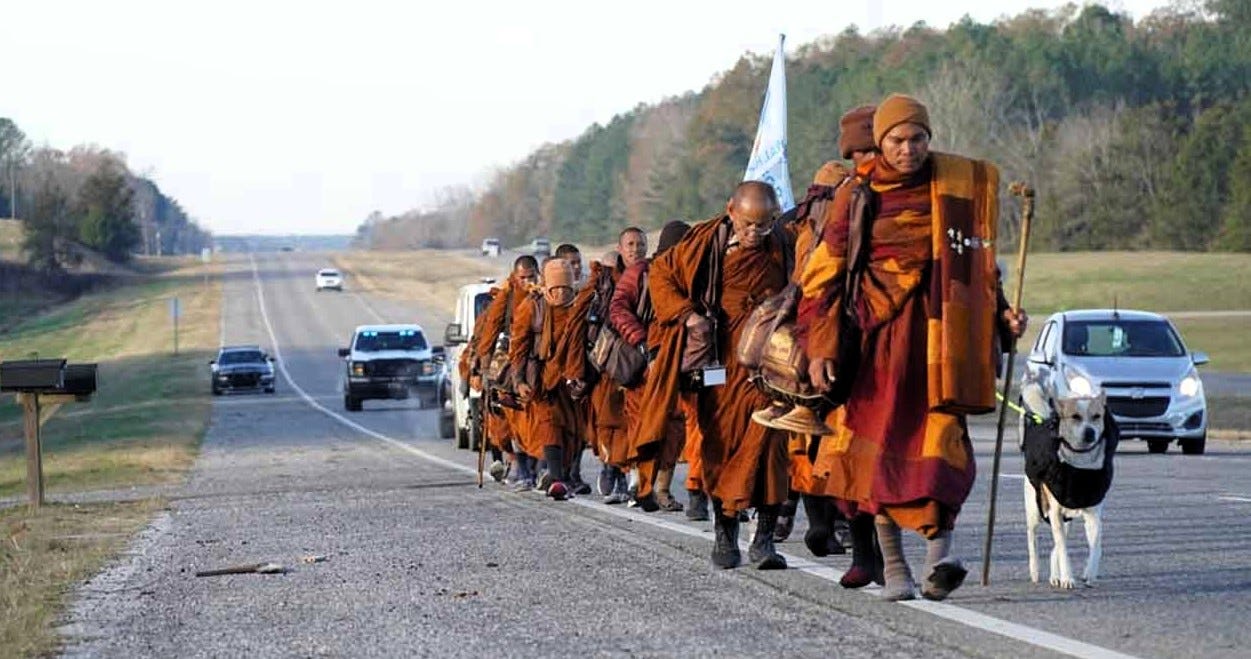
Between 19-24 Theravada Buddhist monks from Vietnam, Thailand, India, Sri Lanka, Cambodia, Laos, and elsewhere agreed to start a walk for peace for 3600 kilometres (2300 miles) from Fort Worth to Washington DC. The Thai Buddhist tradition refers to such pilgrimages as thudong, derived from dhutanga. Pali - language of the Buddha.
Dhutanga means ascetic practice, an apt description for the numerous steps ahead for the next 108 days. Ascetic practices aptly describes the endurance and hardship of such a pilgrimage. Hard core monks of vipassana develop an exceptional resilience in their practice without losing sight of their humanity.
Rather than hang around until warm weather arrived in April, they set off on 26 October 2025, the approach of winter without hiking boots and tough winter clothing from outdoor stores. They wore thin cotton saffron or maroon robes, pullovers, jogging footwear, sandals, socks and sometimes barefooted. They carried their begging bowl, an extra robe and other items.
Their quiet determination to gently remind American citizens of the suffering of war, of violent street rebellions and domestic violence, not through preaching, not through songs for peace or door knocking. The monks let their feet do much of the talking while sharing their concerns when invited.
In conversation with local citizens, they reminded Americans of the value of mindfulness, dissolving the noise in the mind, learning meditation and the power of metta (love, loving kindness and deep friendship).
Leader of the Walk, Bhikkhu (Monk) Pannakara (Wisdom of Action) said they encouraged people to slow down, to spread friendship and to be willing to let go of clinging to make space in their heart for another way of experiencing life.
The monks had no idea what reception, if any, they would receive. USA has more than its fair share of mistrust and aversion towards those who appear different or foreign. That didn’t deter the monks. They set off quietly with little organisation and even less fuss.
As the days and weeks passed by, citizens stopped and watched this oddly dressed single line of monks focussed on mindfulness, step by step - accompanied by an Indian dog. Curiosity triggered citizens’ attention rather than the judgemental mind. Parents brought their kids to see this silent, single file. Nshorna (my daughter) emailed to me links about the Walk for Peace. Many others forwarded links to loved ones.
Named Aloka (Light), the dog known as the Peace Dog, has a story. Some monks took part in a dhutanga in India, where a wild dog living on scraps joined at the back of the single line of monks a year or so before. The monks did not invite nor encourage the animal. As the days and weeks went by, they adopted him. After all, the Buddha taught love and respect for all sentient beings. Buddhists in America raised the money to bring Aloka (means Light) to the Fort Worth monastery.
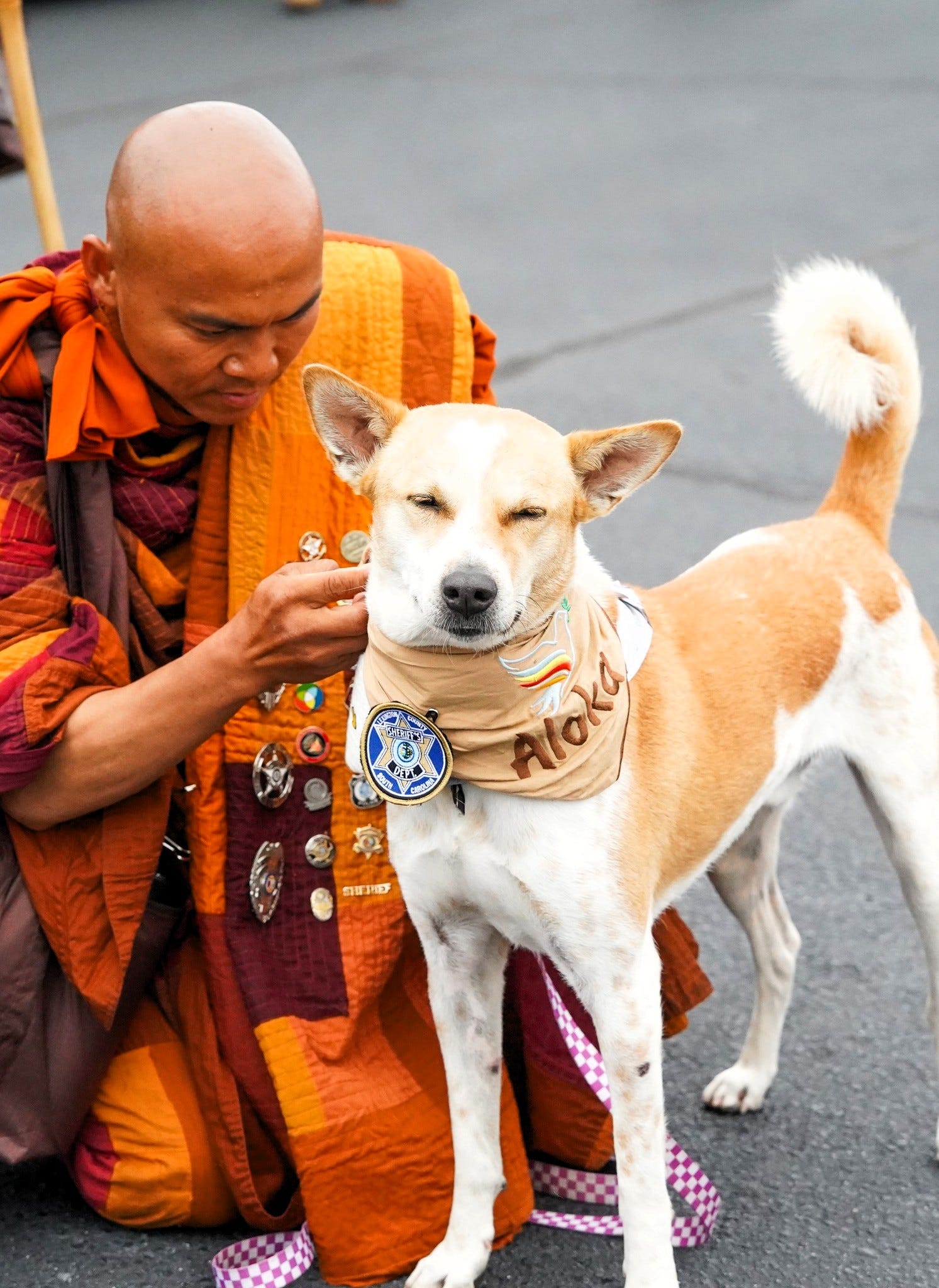
Above, Aloka, the Peace Dog, a veteran of dhutanga.
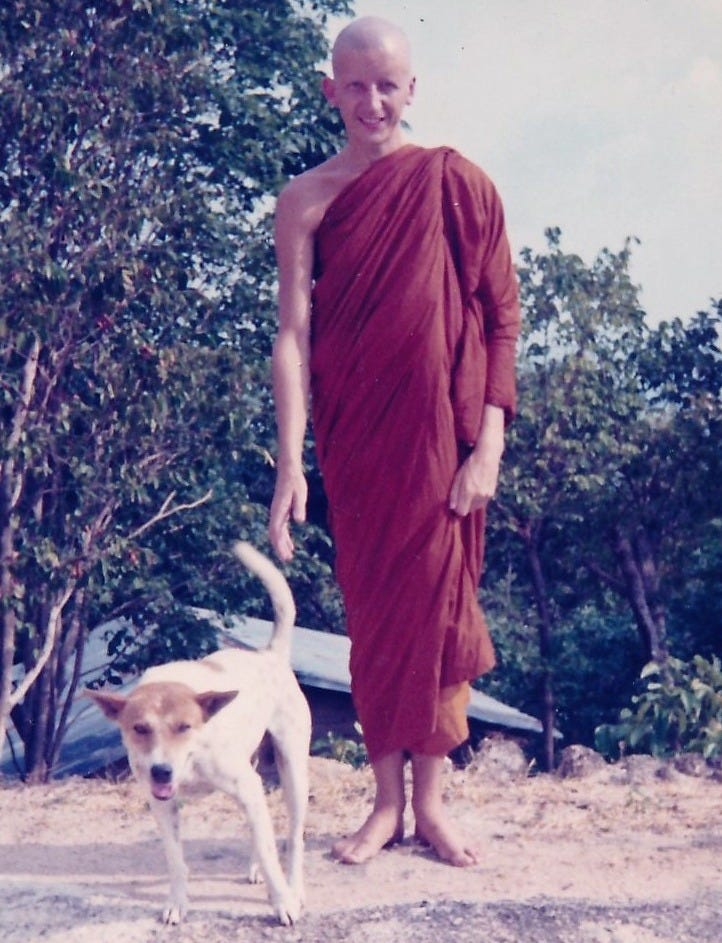
Below. Photo taken in 1973 near the cave where I spent most of that year in the hills on Koh Pha Ngan island. I named him Number One, the Meditator, Every morning, I walked down the track to the village with the begging bowl for alms. Number One followed me back up to the cave. After eating the rather spicy leftovers and drinking water, we abided outside the cave or inside it. We often meditated together looking over the coconut tree grove to the blue sea melting into the blue sky. He then quietly left until the next day. Aloka and Number One seem to be from the same family.
At times, the roads to Washington were caked with patches of ice, merciless winds and temperatures below zero. Undeterred, the monks and Aloka kept walking. Understandably, citizens preferred the warmth of home with central heating and logs burning on the woodstove. The monks were Walking for Peace not Walking to Impress people with their Ascetic Practice. Despite the fierce wintry weather and the falling snow, people by the thousands started to come out of their homes to thank the monks, to let them know of their deep appreciation and renewal in their being for for meaningful change. People joined them for a day, days or weeks.
Social media became a resource during the Walk for Peace. Numbers grew until millions had gone online to see dhutanga in action for a noble purpose. Buddhists in Asian countries experienced a glow in the heart to see the ordained Sangha engaged in such an action in a chilly climate far removed from the tender weather often experienced in South Asia.
Details of the Dhuthong and March for Peace
Monks walked 30 to 40 kilometres per day, mostly barefoot. They ate one meal per day in the morning hours and slept outside. Phew. Tough cookies.
The route took them through nine states. Texas. Louisiana, Mississippi, Alabama, Georgia, South Carolina, North Carolina, Virginia, and into the District of Columbia. The monks stopped in state capitols, churches, community centres and historic sites.
The journey lasted for 108 days, a significant number in the Buddhist tradition. Here’s why.
There are six senses sight, sound, smell, taste and touch. The Buddha said the mind is a sense as it is also an object in consciousness.
There are three kinds of feeling tones/sensations - painful, pleasant or neutral. There are three periods of time, past, present and future. 6 x 3 x 3 = 54.
Experiences arise in two ways - due to impact /impressions from outside of ourselves and from within ourselves. 54 x 2 = 108.
The number 108 represents all the possible experiences available to a human being. That means all of us –without a single exception from Buddhas to those trapped in spell of conditioning.
Truck accidentally crashes into escort vehicle
A car hit the escort vehicle, injuring several people. One monk lost his leg below his knee. He had the operation in Huston, Texas. The monks continued their walk for peace while the public expressed much sympathy for what happened.
Aloka, named the Peace Dog, needed a small operation in Charlottesville, Virginia. Many dog lovers and children came to see the dog walking alongside the monks and laypeople.
People worldwide could track the walk in real time, read the dedicated Facebook page, see live maps and get brief updates. The audience expanded worldwide.
National media reported on the Peace Walk including Reuters, USA Today, PBS, NPR and Fox News, which gave reports. By January, more than a million people followed the walk on different platforms. European countries mostly ignored the event, changing hearts and minds of people.
Civic and Religious Institutions come together
In times of much social division, polarisation and mistrust, civic and religious institutions in cities and towns came together to support the Peace March.
Coverage by local outlets along the route, followed by national media such as NPR, PBS, AP, Reuters, Fox News, and USA Today, amplified awareness far beyond Buddhist circles.
By January 2026, the Walk’s social channels had attracted more than a million followers across platforms, plus posts about Aloka’s injury and surgery in Charlotte, North Carolina, went viral, turning the dog into a symbol of vulnerable, nonviolent courage.
Organizers and reporters consistently describe “thousands” greeting the monks in different states and “millions” inspired or following online, with crowds thickening as they approached Virginia and the D.C. area.
Several state and local officials described the Walk as a rare, hopeful focal point amid headlines dominated by polarisation. The simplicity of the monks walking in silence— no fundraising on the road, and acceptance of whatever food and lodging appeared — touched people.
Lay supporters, including nuns and local clergy of other faiths, periodically joined segments of the walk, though the formal core group remained the monks in their burnt‑orange robes and Aloka the dog.
The Walk, the monk’s aesthetic practices and ongoing metta touched the hearts of citizens recognising ethical integrity, humane values and humble presence, a cornerstone of a Buddhist way of life.
Five Seconds of Mindfulness
Upon arrival in Washington DC, Venerable Paññākāra thanked the police, fire departments, doctors, and families who supported them along the way.
He then invited the audience to practice “5 Seconds of Mindfulness”:
Second 1–Loving Kindness: Stop before causing harm and soften before speaking.
Second 2–Compassion: Understand that we do not know what pain others carry.
Second 3–Love: Truly love yourself and the person in front of you.
Second 4–Harmony: Choose living together over winning.
Second 5—Hope: Believe that violence is not the final answer.
Joining him on stage was the Venerable Phra Ajarnh Maha Dam Phommasan, who lost part of his leg.
“At that moment, I thought maybe I was going to die. But practicing mindfulness meditation during our walks was really helpful when I faced death. I invite all of you to practice as well.”
Final Word
Sadhu. Sadhu. Sadhu (Well Said, Well Said, Well Said).
May all beings live in peace
May all beings live in harmony
May all beings live in peace and harmony.
Alas, the bitter winds sent from Israel cannot hear the Buddha’s call for peace!